Optical Parametric Chirped Pulse Amplification (OPCPA)
Overcoming the constraints of conventional gain media, OPCPA delivers wavelength-tunable, high-power amplification of ultrashort pulses.
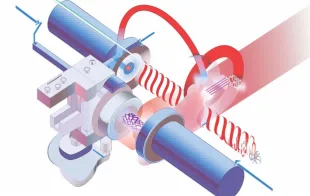
Optical Parametric Chirped Pulse Amplification (OPCPA) is an advanced laser amplification technology of important standing in the field of laser physics. It mainly amplifies a chirped, low-energy pulse through an optical parametric process in a nonlinear medium. In this process, a strong laser field (usually called the pump light) interacts with the chirped pulse in the nonlinear medium, causing a significant increase in the chirped pulse’s energy. This energy-transfer process differs from traditional direct-electronic-excitation amplification; it is achieved through an optical parametric process in which the energy of the pump light is transferred to the chirped pulse.
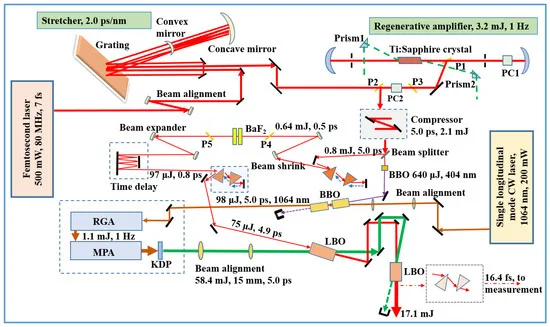
Figure: Schematic of the optically synchronized front end of a petawatt-class laser. P1–P5, polarizers; PC1–PC2, Pockels cells; RGA, regenerative amplifier; MPA, main power amplifier.
The key advantage of OPCPA lies in its ability to amplify extremely short pulses, which is crucial for applications such as precision metrology, femtosecond photochemistry experiments, and quantum control. For example, in precision metrology, ultrashort pulses can be used to precisely measure the optical properties of matter; in femtosecond photochemistry, they can be used to study the ultrafast processes of chemical reactions; in quantum control, ultrashort pulses are key to precisely manipulating quantum states.
OPCPA is indispensable in many scientific fields, especially those requiring high-intensity, ultrashort laser pulses. It not only improves the precision and efficiency of experiments but also broadens the possibilities of scientific research, enabling researchers to explore phenomena previously difficult or impossible to observe. This technology plays an important role in physics, chemistry, biology, materials science, and more.
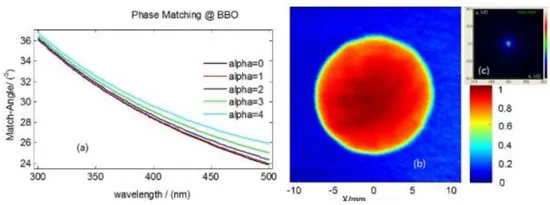
Figure: Phase-matching angle calculation of a BBO crystal at 404 nm and 1064 nm (a); spatial distribution of the sheared pump pulse (1064 nm) (b); far-field distribution of the sheared pump pulse (1064 nm) (c).
In OPCPA, the chirped pulse produced by the femtosecond laser is the object to be amplified. These ultrashort pulses have extremely high peak power and broad spectral characteristics, making them an ideal seed source. A key advantage of OPCPA is that it allows reaching extremely high peak power without damaging the laser gain medium. This means higher-intensity laser output can be achieved without damaging the equipment.
By using nonlinear optical processes, OPCPA greatly enhances the laser’s energy while maintaining the laser pulse width. This makes OPCPA an ideal technology for producing high-intensity femtosecond laser pulses. As OPCPA technology continues to improve and develop, it is expected to play an even more important role in future scientific research and technological applications.