Color-Center Formation
Color center formation refers to the generation of point defects in transparent crystals or glass materials—typically induced by femtosecond laser irradiation or high-energy radiation—which create localized absorption bands and are exploited in solid-state laser gain media, optical data storage, and quantum memory applications.
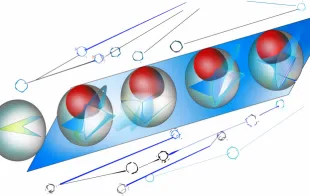
Color centers, also known as F-centers, are special structures in crystalline materials produced by atomic defects, able to absorb light of specific wavelengths and cause the crystal to display a specific color. Such defects are usually vacancies left when a certain atomic ion (such as an alkali-metal ion) is removed from a crystal lattice site, causing surrounding electrons to form localized energy levels near the vacancy. These electrons can be photoexcited to these energy levels, thereby absorbing light of specific wavelengths and giving the crystal color. The formation of color centers can be caused by various factors, including radiation damage, chemical reactions, or physical processing.
In wide-bandgap semiconductor materials such as diamond, color centers have been widely studied, especially as candidates for qubits. These color centers have stable quantum states and can serve as the basic units in quantum information processing. The application of femtosecond lasers in this field mainly includes the precise preparation and manipulation of these qubits, offering new possibilities for quantum information processing. Because the femtosecond laser pulse duration is extremely short and can produce highly localized energy deposition inside a material, it is an ideal tool for creating and modifying color centers.
The femtosecond laser shows unique advantages in the formation and manipulation of color centers. This process usually involves nonlinear optical effects and electronic reorganization inside the material. The femtosecond laser can precisely control the position and depth of energy deposition, thereby producing or modifying color centers in a crystal without damaging surrounding material.
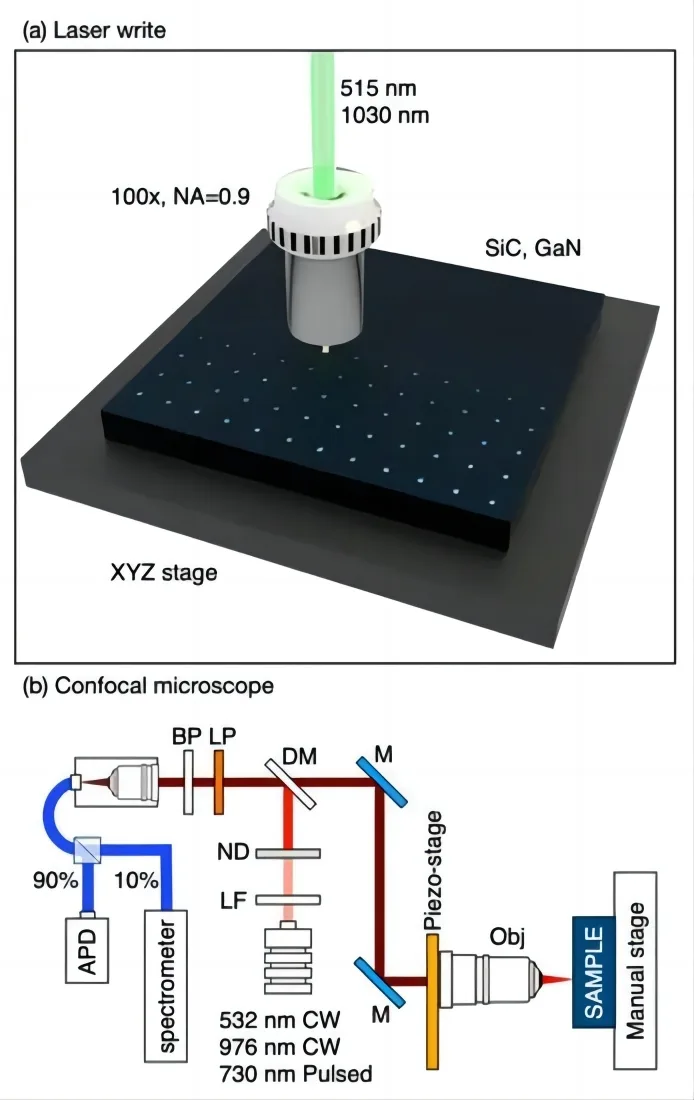
Figure 1: (a) Conceptual diagram of the laser-writing system used to create color centers; (b) schematic of a confocal fluorescence microscope.
In the field of optical data storage, femtosecond lasers are used to precisely produce color centers in materials, achieving high-density data encoding. This method utilizes the optical properties of different color centers inside the crystal, such as absorption and emission characteristics. By controlling femtosecond-laser parameters such as wavelength, pulse duration, and focusing characteristics, color centers with different optical characteristics can be created in the crystal, thereby achieving high-density data storage.
In addition, the application of femtosecond lasers in color-center formation has also promoted the development of new materials and technologies. In quantum computing and quantum communication, the application of femtosecond laser technology provides new methods for the preparation and operation of qubits.