Surface Micro/Nano Structures
Surface micro- and nanostructures refer to precisely patterned features on material surfaces at the micron or nanometer scale, which are fabricated by ultrafast laser processing to endow surfaces with customized optical, wetting, adhesion, or tribological properties.
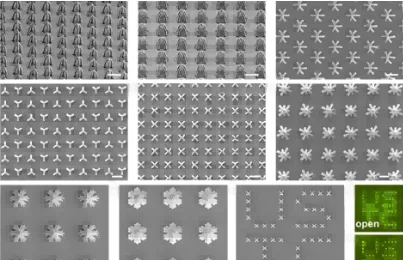
Surface micro/nano structures refer to microscopic and nanoscale geometric or physical structures on a material surface, usually with dimensions between a few nanometers and a few micrometers. These micro/nano structures can appear as uneven surface textures, tiny protrusions, or grooves. These features are far smaller in scale than the limits achievable by traditional processing techniques. Using femtosecond laser technology, one can finely manipulate a material surface with extremely high precision to form the desired micro/nano structures.
The research and application of surface micro/nano structures are significant in many fields such as materials science, optical engineering, and biomedicine. By precisely controlling the micro/nano structures of a surface, these structures can endow the material with unique properties such as superhydrophobicity, improved friction characteristics, and special optical properties. The following are some main properties and their applications:
1. Superhydrophobicity and superoleophobicity: By creating specific micro/nano structures on a material surface, superhydrophobic (water droplets cannot stay on the surface) and superoleophobic (oil droplets cannot stay on the surface) effects can be achieved. This property is very useful for making self-cleaning surfaces, such as in building materials, automotive coatings, and waterproof clothing.
2. Improved friction characteristics: Micro/nano structures can be used to adjust the friction characteristics of a material surface. For example, in industrial machine components, precisely designing the surface structure can reduce wear and friction, extending equipment life.
3. Special optical properties: Surface micro/nano structures can be used to manipulate the reflection, refraction, and scattering of light. This is especially important for making materials with special visual effects (such as anti-counterfeiting labels) or improving the efficiency of solar cells.
4. Enhanced chemical and biological compatibility: In biomedicine, surface micro/nano structures can improve the compatibility of a material with biological tissue, promoting cell growth and attachment. For example, in the surface design of implanted medical devices or tissue-engineering scaffolds.
5. Enhanced sensing and catalytic performance: By increasing the surface area, micro/nano structures can improve the sensing sensitivity and catalytic efficiency of a material. This has important applications in environmental monitoring, biological detection, and the chemical industry.
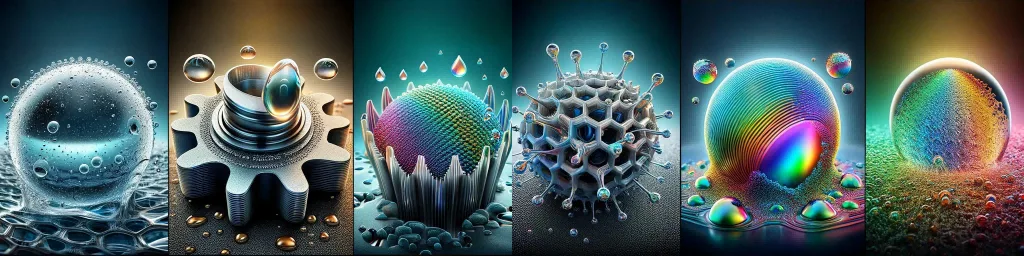
Figure: Surface micro/nano structures fabricated by a femtosecond laser.
The fabrication of surface micro/nano structures, especially through femtosecond laser technology, enables us to design and manufacture these highly complex and powerful surface structures with unprecedented precision and flexibility. Because of its extremely short pulse width and high peak power, the femtosecond laser can produce precise micro/nano-scale processing on a material surface without causing thermal damage to surrounding material. This characteristic makes the femtosecond laser an ideal tool for fabricating complex micro/nano structures, especially in applications with extremely high requirements for precision and surface integrity.