40 W Main Oscillator + OPA + SHG + DFG - Five Units, One Bench, 315 nm – 16 μm
HELIOS-40W-HP、AURORA-HE、Femtosecond Laser、Yb Laser、OPA、SHG、DFG、Mid IR、Molecular Fingerprint、Ultrafast Spectroscopy、Transient Absorption、Photonics
August 21, 2026
In ultrafast spectroscopy, whether an experiment runs comes down to whether the driver wavelength matches the target absorption band. The π–π* electronic transitions of aromatic molecules sit in the near-UV to violet-visible window (~250 – 400 nm, extending to ~450 nm for larger conjugated systems). Chromophore absorption in biology and the MLCT (metal-to-ligand charge-transfer) bands of transition-metal complexes fall in the visible (400 – 650 nm). Perovskite band edges and TMD excitonic transitions lie in the visible-to-NIR (500 – 1000 nm). Charge-transfer (CT) states in organic donors–acceptors (~800 – 1500 nm) and interband absorption in colloidal quantum dots (~600 nm – 2.5 μm) live in the NIR-to-SWIR. And molecular vibrational fingerprints live in the mid-IR (~2 – 20 μm): C-H / O-H / N-H / C=O stretches, Amide I / II bands, DNA phosphate-backbone stretches, and M-O phonon modes of inorganic oxides.
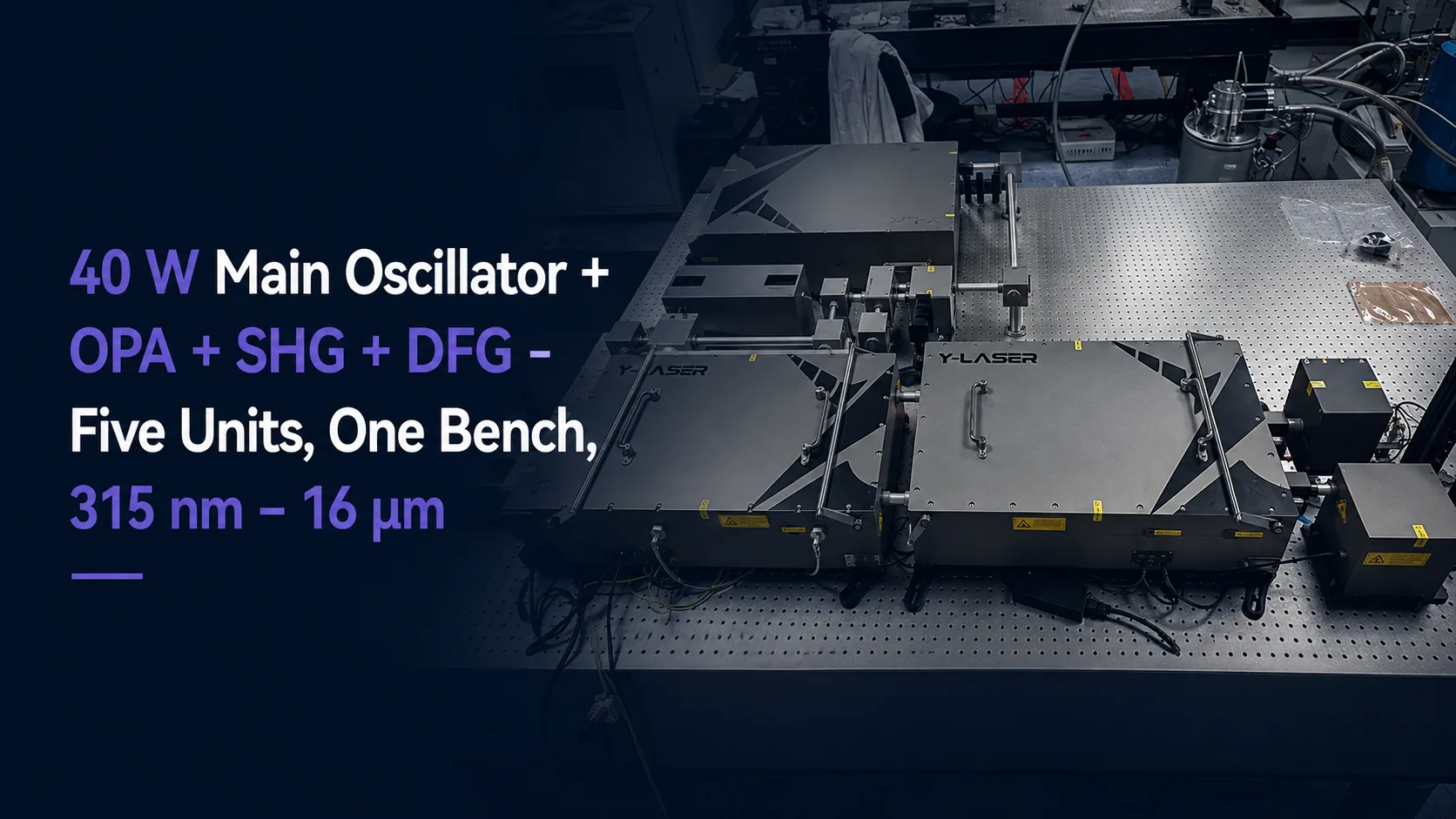
Y-LASER’s five-unit configuration — HELIOS-40W-HP + AURORA-HE + standalone SHG + standalone DFG1 + standalone DFG2 — is engineered against exactly this cross-cutting requirement. All five units are Y-LASER products, delivered together, calibrated together, and installed on a single bench as one tuned optical chain that spans 315 nm to 16 μm continuously.

1 · Highlights at a Glance
Highlight | Value / Detail |
System | Y-LASER HELIOS-40W-HP + AURORA-HE OPA + standalone SHG + standalone DFG1 + standalone DFG2 (five-unit configuration) |
Main oscillator | 1030 nm / 44.2 W / 199.4 fs / 442 μJ · Yb-CPA · 100 kHz |
OPA Signal tuning | 630 – 1030 nm · Peak 3220 mW @ 700 nm (10.4 %) |
OPA Idler tuning | 1030 – 2600 nm · Peak 1921 mW @ 1100 nm (6.4 %) |
SHG · SHS deep-UV | 315 – 515 nm · Peak 1113 mW @ 400 nm (3.6 %) |
SHG · SHI visible | 515 – 630 nm · Peak 815 mW @ 550 nm (2.63 %) |
DFG1 mid-IR | 2.2 – 4.1 μm · Peak 1640 mW @ 2.9 μm (5.3 %) |
DFG2 far mid-IR | 4 – 16 μm · Peak 125 mW @ 7 μm (0.4 %) |
Full coverage | 315 nm – 16 μm continuous · UV / VIS / NIR / SWIR / MIR / LWIR — six spectral regions |
Main-oscillator stability | 24 h power 0.04 % RMS · M² < 1.11 |
OPA output stability | 24 h power 0.55 % RMS @ 780 nm |
2 · OPA + SHG + DFG in 30 seconds
In plain terms:
▪ ▶ OPA (Optical Parametric Amplification) — inside a nonlinear crystal, one 1030 nm pump photon "splits" into a Signal photon and an Idler photon under energy conservation ω_p = ω_s + ω_i. Rotating the crystal moves the Signal continuously from 630 to 1030 nm; the Idler tracks by energy conservation from 1030 to 2600 nm on the other side.
▪ ▶ SHG (Second-Harmonic Generation) — two fundamental photons at ω "combine" into one 2ω photon, halving the wavelength. Doubling the OPA Signal covers 315 – 515 nm deep-UV (SHS); doubling the Idler covers 515 – 630 nm visible (SHI).
▪ ▶ DFG (Difference-Frequency Generation) — two higher-energy photons (e.g., Signal & Idler) "subtract" to yield a longer-wavelength mid-IR photon at ω₁ − ω₂. DFG1 delivers 2.2 – 4.1 μm (group-frequency region, ~2400 – 4500 cm⁻¹); DFG2 delivers 4 – 16 μm (molecular fingerprint region, ~625 – 2500 cm⁻¹).
Combined, OPA + SHG + DFG turn one 1030 nm Yb main oscillator into a continuous 315 nm – 16 μm tunable femtosecond source spanning six orders of magnitude in wavelength.
3 · A Five-Unit Y-LASER Configuration
The full system consists of five separate units — every one designed, built, and calibrated by Y-LASER — installed as a single tuned optical chain on one bench:
▪ HELIOS-40W-HP high-power main oscillator — 1030 nm Yb-CPA · 44.2 W average power · 100 kHz / 442 μJ / 199.4 fs · 24 h power stability 0.04 % RMS · M² < 1.11.
▪ AURORA-HE OPA — optical parametric amplifier; Signal 630 – 1030 nm and Idler 1030 – 2600 nm continuously tunable; peak conversion 10.4 % @ 700 nm.
▪ Standalone SHG doubling stage — separate chassis, fed by OPA Signal / Idler; SHS 315 – 515 nm deep-UV + SHI 515 – 630 nm visible.
▪ Standalone DFG1 stage — separate chassis, fed by OPA Signal + Idler; 2.2 – 4.1 μm mid-IR (C-H / O-H / N-H stretch region).
▪ Standalone DFG2 stage — separate chassis; 4 – 16 μm far mid-IR, covering the molecular fingerprint region (Amide I / II bands, DNA phosphate backbone, M-O phonon modes of inorganic oxides).
Because all five units come from a single design house, the polarization, dispersion, phase-matching handoffs and beam-height interfaces between them are calibrated together at the factory and finalized during on-site commissioning — removing the interface-loss and drift issues typical of multi-vendor mid-IR chains.
4 · Why It Matters — the Data Speaks
■ Advantage 1 · HELIOS-40W-HP main oscillator: 44 W · 24 h 0.04 % RMS
The main oscillator caps how much conversion the whole chain can extract. HELIOS-40W-HP delivers 44.2 W average power at the 100 kHz working point (442 μJ single-pulse energy, 199.4 fs); 24 h power stability sits at 0.04 % RMS and M² is below 1.11 — a top-tier envelope for driving downstream OPA, SHG and DFG stages.
 |  |
HELIOS-40W-HP | Output Spectrum @ 100 kHz · λc = 1037.9 nm | HELIOS-40W-HP | Autocorrelation @ 100 kHz · Pulse Duration = 199.4 fs (FWHM) |
 |  |
HELIOS-40W-HP | 24 h Power Stability · 44.2 W · 0.04 % RMS | HELIOS-40W-HP | 24 h Pointing Stability · 1.91 μrad · RMS = 0.955 μm |
■ Advantage 2 · OPA Signal tuning spectra (630 – 1030 nm)
More than 24 tuning wavelengths across 630 – 1030 nm — each with a clean, complete peak, uniform amplitude, and no distortion at adjacent points. Peak conversion 10.4 % @ 700 nm, peak power 3220 mW — enough visible-to-NIR photon flux for downstream TA pump-probe.
■ Advantage 3 · OPA Idler tuning spectra (1030 – 2600 nm)
Idler covers the NIR and SWIR — peak 1921 mW @ 1100 nm (6.4 %). Beyond direct TA probing, the Idler is the crucial seed for the downstream DFG stages, where mid-IR photons are generated by mixing Signal and Idler.
 |  |
AURORA-HE OPA | Signal Tuning Spectra (630 – 1030 nm) | AURORA-HE OPA | Idler Tuning Spectra (1030 – 2600 nm) |
■ Advantage 4 · Standalone SHG · deep-UV extension (SHS · 315 – 515 nm)
Doubling the OPA Signal covers 315 – 515 nm near-UV to violet-visible — the window of the π–π* electronic transitions of aromatic molecules, the MLCT bands of transition-metal complexes, and the UV absorption windows of catalytic intermediates. Peak SHS conversion 3.6 % @ 400 nm, peak power 1113 mW.
■ Advantage 5 · Standalone SHG · visible extension (SHI · 515 – 630 nm)
Doubling the OPA Idler covers 515 – 630 nm in the visible — filling the gap between OPA Signal at 630 nm and SHS at 515 nm, so the tuning is truly continuous across every spectral region. Peak SHI conversion 2.63 % @ 550 nm, peak power 815 mW — suitable for chromophore, photosensitive-protein and fluorescent-probe excited-state dynamics.
 |  |
Standalone SHG | SHS Tuning Spectra (315 – 515 nm) | Standalone SHG | SHI Tuning Spectra (515 – 630 nm) |
■ Advantage 6 · Standalone DFG1 · mid-IR (2.2 – 4.1 μm) ★ group-frequency region
DFG1 covers the ~3000 – 4500 cm⁻¹ group-frequency region: C-H stretches (~3.3 μm / 3000 cm⁻¹), O-H stretches (~2.7 – 3.0 μm), and N-H stretches (~2.9 – 3.1 μm). Peak conversion 5.3 % @ 2.9 μm, peak power 1640 mW — plenty of mid-IR photon flux for catalytic intermediates, photochemistry and TA-MIR.
■ Advantage 7 · Standalone DFG2 · far mid-IR (4 – 16 μm) ★ molecular fingerprint region
DFG2 covers the molecular fingerprint region (~500 – 1500 cm⁻¹ / 6.7 – 20 μm): protein Amide I band (~1650 cm⁻¹ / 6.06 μm) and Amide II band (~1550 cm⁻¹ / 6.45 μm), DNA phosphate-backbone asymmetric stretch (~1240 cm⁻¹ / 8.1 μm) and symmetric stretch (~1080 cm⁻¹ / 9.3 μm), plus M-O phonon modes of inorganic oxides (~400 – 1000 cm⁻¹). This band has historically been the territory of QCLs and free-electron lasers; delivering it from a table-top femtosecond OPA + DFG chain is the key differentiator of this configuration versus a conventional 315 – 2600 nm OPA + SHG. Peak conversion 0.4 % @ 7 μm, peak power 125 mW.
 |  |
Standalone DFG1 | Mid-IR Tuning Spectra (2.2 – 4.1 μm) | Standalone DFG2 | Far-Mid-IR Tuning Spectra (4 – 16 μm) |
■ Advantage 8 · Full tuning curve — 315 nm – 16 μm in one view
Signal + Idler + SHS + SHI + DFG1 + DFG2 on the same axis — the horizontal axis runs from 315 nm to 16 μm across all six spectral regions. The six arms stitch together seamlessly, giving a direct visual of what "five units, one bench, six spectral regions" actually delivers.

AURORA-HE + SHG + DFG | Full Spectral Tuning Curve (315 nm – 16 μm)
5 · Experiments Unlocked by One Bench
▪ Femtosecond mid-IR transient absorption (TA-MIR) — DFG1 + DFG2 cover 2 – 16 μm molecular vibrational bands for catalytic intermediates, photochemistry, and fingerprint-region probing.
▪ Transient vibrational spectroscopy (TVS) — Amide I / II bands of proteins, DNA phosphate backbone modes, and other biomolecular conformational dynamics on the femtosecond time scale.
▪ Vibrational sum-frequency generation (VSFG) — interfacial molecular structure and dynamics.
▪ TMD exciton–phonon coupling — OPA Signal / Idler probe the excitonic transitions; DFG probes low-frequency phonon modes.
▪ UV-Vis TA pump-probe — SHS + SHI cover aromatic π–π* transitions, MLCT bands, and biological chromophore absorption.
6 · Closing Notes
44 W main oscillator · 10.4 % Signal peak · 6.4 % Idler peak · 3.6 % SHS peak · 5.3 % DFG1 peak · 315 nm – 16 μm continuous tuning · main-oscillator 24 h stability 0.04 % RMS — the numbers delivered by Y-LASER HELIOS-40W-HP + AURORA-HE + standalone SHG + standalone DFG1 + standalone DFG2 map one-to-one onto the six physical requirements that ultrafast mid-IR spectroscopy experiments actually depend on: main-oscillator power, Signal efficiency, Idler efficiency, UV extension, mid-IR coverage, and long-term stability.
The standalone DFG2 unit — pushing the tuning out to 16 μm across the molecular fingerprint region — is the key differentiator that sets this configuration apart from a conventional OPA + SHG combination. Because all five units come from the same vendor, the polarization, dispersion, phase-matching handoffs and beam-height interfaces between them are calibrated together at the factory and finalized during on-site commissioning — physically lowering the baseline noise floor of every downstream TA / TVS signal.