40 W Main Oscillator + OPA + SHG + THG - Four Units, One Bench, 210 – 2930 nm
HELIOS-40W-HP、AURORA-HP、Femtosecond Laser、Yb Laser、OPA、SHG、THG、Tunable Laser、Ultrafast Spectroscopy、Transient Absorption、Deep UV、Photonics
August 15, 2026
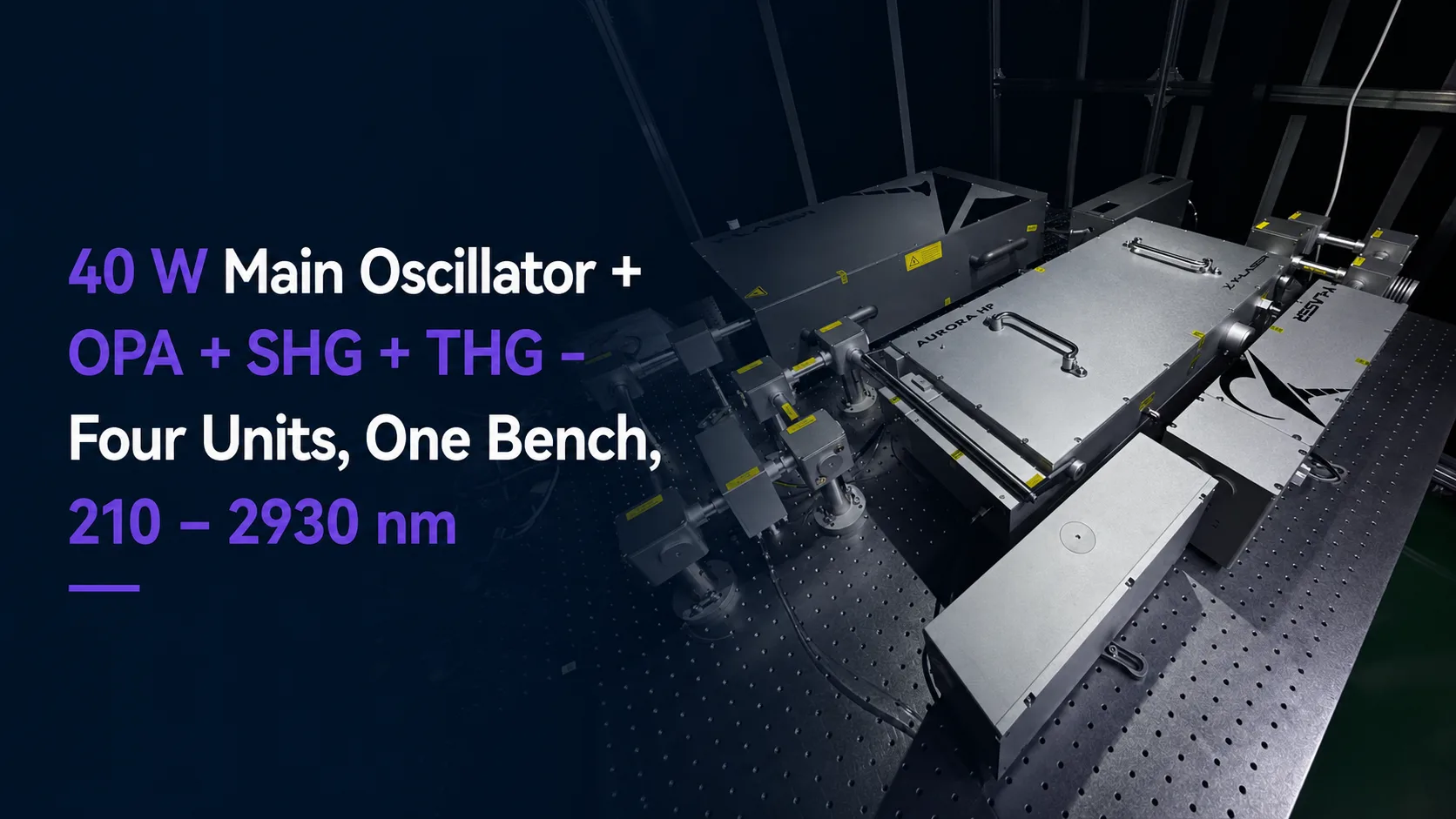
Over the last decade, 1030 nm Yb femtosecond lasers have become the de-facto standard for ultrafast platforms. But in real TA pump-probe, photochemistry, materials photophysics, biological chromophore dynamics and deep-UV ultrafast spectroscopy work, 1030 nm is only the starting point. What actually decides whether an experiment runs is whether the driver can move freely across the entire absorption landscape — from the DUV window of DNA / protein absorption and high-lying Rydberg states in photochemistry intermediates (210 – 315 nm), through π–π* electronic transitions (315 – 450 nm), perovskite band edges (500 – 800 nm), quantum-dot interband absorption (600 nm – 2.5 μm), organic CT states (800 – 1500 nm), all the way out to biological tissue windows in the SWIR.
Y-LASER’s solution is a four-unit configuration engineered against exactly this cross-cutting requirement: a 40 W Yb main oscillator, an OPA, a standalone SHG stage and a standalone THG stage — all four are Y-LASER products, delivered together, calibrated together, and installed as one tuned optical chain on a single bench. Five output arms (Signal + Idler + SHS + SHI + THS) stitch together to give a continuous 210 – 2930 nm tunable femtosecond source.

1 · Highlights at a Glance

2 · OPA + SHG + THG in 30 seconds
In plain terms:
▪ ▶ OPA (Optical Parametric Amplification) — inside a nonlinear crystal (BBO / LBO), one 1030 nm pump photon "splits" into a Signal photon and an Idler photon under energy conservation ω_p = ω_s + ω_i and momentum conservation k_p = k_s + k_i. Rotating the crystal moves the Signal continuously from 630 to 1037 nm; the Idler tracks by energy conservation from 1037 to 2930 nm on the other side.
▪ ▶ SHG (Second-Harmonic Generation) — two fundamental photons at ω combine into one 2ω photon, halving the wavelength. Doubling the Signal into an SHG crystal extends the tuning into 315 – 515 nm deep-UV (SHS); doubling the Idler covers 520 – 650 nm in the visible (SHI).
▪ ▶ THG (Third-Harmonic Generation) — three fundamental photons combine into one 3ω photon, cutting the wavelength to one third. Tripling the Signal extends the reach into 210 – 315 nm DUV (THS) — the window of choice for high-lying Rydberg states of photochemistry intermediates, DNA / protein UV absorption, and catalytic interface DUV transitions.
Combined, OPA + SHG + THG turn one 1030 nm Yb main oscillator into a continuous 210 – 2930 nm tunable femtosecond source spanning roughly fourteen frequency octaves.
3 · A Four-Unit Y-LASER Configuration
The full system consists of four separate units — every one designed, built and calibrated by Y-LASER — installed as a single tuned optical chain on one bench:
▪ HELIOS-40W-HP high-power main oscillator — 1030 nm Yb-CPA · 44 W average power · 100 kHz / 440 μJ / 244.7 fs · 24 h power stability 0.03 % RMS · pointing 0.70 μrad · M² < 1.09.
▪ AURORA-HP OPA — optical parametric amplifier; Signal 630 – 1037 nm and Idler 1037 – 2930 nm continuously tunable; software-controlled wavelength switching; peak conversion 11.6 % @ 700 nm.
▪ Standalone SHG doubling stage — separate chassis, fed by OPA Signal or Idler; SHS 315 – 515 nm deep-UV + SHI 520 – 650 nm visible.
▪ Standalone THG tripling stage — separate chassis, fed by OPA Signal; THS 210 – 315 nm DUV extension — the four units together open the full 210 – 2930 nm range.
Because all four units come from a single design house, the polarization, dispersion, phase matching and beam-height interfaces between them are calibrated together at the factory and finalized during on-site commissioning — removing the interface-loss and drift issues typical of multi-vendor optical chains.
4 · Why It Matters — the Data Speaks
■ Advantage 1 · HELIOS-40W-HP main oscillator: 44 W · 24 h 0.03 % RMS
The main oscillator sets the ceiling for the whole chain. HELIOS-40W-HP delivers 44 W average power at the 100 kHz working point (440 μJ single-pulse energy, 244.7 fs); measured at the 10 kHz group over 24 h, power stability is 0.03 % RMS, pointing stability is 0.70 μrad, and M² is below 1.09 — a top-tier envelope that directly caps how much conversion efficiency the downstream OPA / SHG / THG stages can extract.
 |  |
HELIOS-40W-HP | Output Spectrum · λc = 1037 nm | HELIOS-40W-HP | Autocorrelation · Pulse Duration = 244.7 fs (FWHM) |
 |  |
HELIOS-40W-HP | 24 h Power Stability · 44 W · 0.03 % RMS | HELIOS-40W-HP | 24 h Pointing Stability · 0.70 μrad |
■ Advantage 2 · OPA Signal tuning spectra (630 – 1037 nm)
AURORA-HP Signal spectra stepped across 630 – 1037 nm — more than 33 tuning wavelengths, each with a clean, complete peak and uniform amplitude, no distortion between adjacent points. This spectral consistency lets every tuning point plug straight into the downstream TA experiment without re-alignment.
■ Advantage 3 · OPA Idler tuning spectra (1037 – 2930 nm)
Idler spectra stepped from 1037 nm out to 2930 nm — extending beyond the 1030 – 2600 nm specification, and covering both the near-IR and SWIR bands relevant to organic vibrational modes, semiconductor interband transitions, quantum-dot SWIR features and biological transmission windows.
 |  |
AURORA-HP OPA | Signal Tuning Spectra (stepped scan 630 – 1037 nm) | AURORA-HP OPA | Idler Tuning Spectra (stepped scan 1037 – 2930 nm) |
■ Advantage 4 · Standalone SHG · Deep-UV extension (SHS · 315 – 515 nm)
The standalone SHG unit doubles the OPA Signal into 315 – 515 nm deep-UV / visible — the region of π–π* electronic transitions, MLCT bands in metal complexes and catalytic-intermediate UV absorption windows. Polarization, dispersion and phase matching between the OPA output port and the SHG input port are calibrated together by the Y-LASER team, removing the conversion-efficiency losses that typically appear when a third-party SHG is bolted onto an existing OPA in the field.
■ Advantage 5 · Standalone SHG · Visible extension (SHI · 520 – 650 nm)
The same standalone SHG unit doubles the OPA Idler into 520 – 650 nm — covering the green-to-red visible band and filling the gap between Signal at 630 nm and SHS at 515 nm, so the 210 – 2930 nm tuning is truly continuous across every spectral region.
 |  |
Standalone SHG | SHS Tuning Spectra (315 – 515 nm) | Standalone SHG | SHI Tuning Spectra (520 – 650 nm) |
■ Advantage 6 · Standalone THG · DUV extension (THS · 210 – 315 nm) ★ key differentiator
The standalone THG unit triples the OPA Signal into 210 – 315 nm DUV — the differentiator that sets this system apart from a conventional 315 – 2600 nm OPA + SHG combination. DUV is exactly where high-lying Rydberg states of photochemistry intermediates, DNA / protein UV absorption bands and catalytic interface DUV transitions live. In a legacy setup this band typically requires a separately purchased DUV source; here the THG unit is delivered by the same vendor and calibrated with the rest of the chain out of the box.
 | |
Standalone THG | THS Tuning Spectra (210 – 315 nm) |
■ Advantage 7 · Full tuning curve — 210 – 2930 nm in one view
Signal + Idler + SHS + SHI + THS on the same axis — the horizontal axis runs from 210 to 2930 nm across all five spectral regions, and the logarithmic vertical axis captures the full 10 mW – 5000 mW power envelope in a single view. The five arms stitch together seamlessly, giving a direct visual of what "one bench, four units, five arms" actually delivers.
 | |
AURORA-HP + SHG + THG | Full Spectral Tuning Curve · Signal 4641 mW @ 700 nm (11.6 %) · Idler 3488 mW @ 1037 nm (8.72 %) · SHS 1228 mW @ 513 nm (3.07 %) · SHI 1206 mW @ 520 nm (3.015 %) · THS 288 mW @ 295 nm (0.72 %) |
■ Advantage 8 · OPA 24 h power stability — 0.2451 % RMS @ 750 nm
Monitored continuously over 24 hours at the 750 nm working point, OPA output RMS stability settles at 0.2451 % — comfortably inside the <1 % specification. This directly controls the baseline noise floor of every downstream TA differential signal through the ΔA ∝ √(t/τ) statistical relation.
 | |
AURORA-HP OPA | 24 h Power Stability @ 750 nm · 0.2451 % RMS |
5 · Experiments Unlocked by One Bench
▪ DUV ultrafast spectroscopy (210 – 315 nm, THS) — high-lying Rydberg states of photochemistry intermediates, DNA / protein UV absorption, catalytic interface DUV transitions.
▪ UV-Vis TA pump-probe (315 – 650 nm, SHS + SHI + Signal front end) — π–π* electronic transitions, MLCT bands, biological chromophore absorption.
▪ Vis-NIR TA pump-probe (630 – 1037 nm, OPA Signal) — perovskite band edges, TMD excitons, quantum-dot interband absorption.
▪ SWIR ultrafast spectroscopy (1037 – 2930 nm, OPA Idler) — organic vibrational modes, semiconductor interband transitions, biological transmission windows.
▪ High-photon-budget TA / photochemistry — the 40 W main oscillator gives the whole chain generous margin on photon flux and duty cycle.
6 · Closing Notes
44 W main oscillator · 11.6 % Signal peak · 8.72 % Idler peak · 3.07 % SHS peak · 0.72 % THS peak · 210 – 2930 nm continuous tuning · main-oscillator 24 h stability 0.03 % RMS — the six numbers delivered by Y-LASER HELIOS-40W-HP + AURORA-HP + standalone SHG + standalone THG map one-to-one onto the six physical requirements that a tunable ultrafast spectroscopy experiment actually depends on: main-oscillator power, Signal efficiency, Idler efficiency, UV extension, DUV extension and long-term stability.
The standalone THG unit — extending the reach to 210 nm — is the key differentiator that sets this configuration apart from a conventional OPA + SHG combination, and it is what lets four coordinated units cover the full DUV → SWIR range on a single bench. Because all four units come from the same vendor, polarization / dispersion / phase-matching handoffs between the OPA output port and the SHG / THG input ports are calibrated together at the factory and finalized during on-site commissioning — physically lowering the baseline noise floor of every downstream TA signal.