Femtosecond Lasers and Tunable Ultrafast Spectroscopy
HELIOS-20W-HE、AURORA-HE、Femtosecond Laser、OPA、SHG、Ultrafast Spectroscopy、Transient Absorption、PumpProbe、SWIR、UV Spectroscopy、Photonics
July 3, 2026
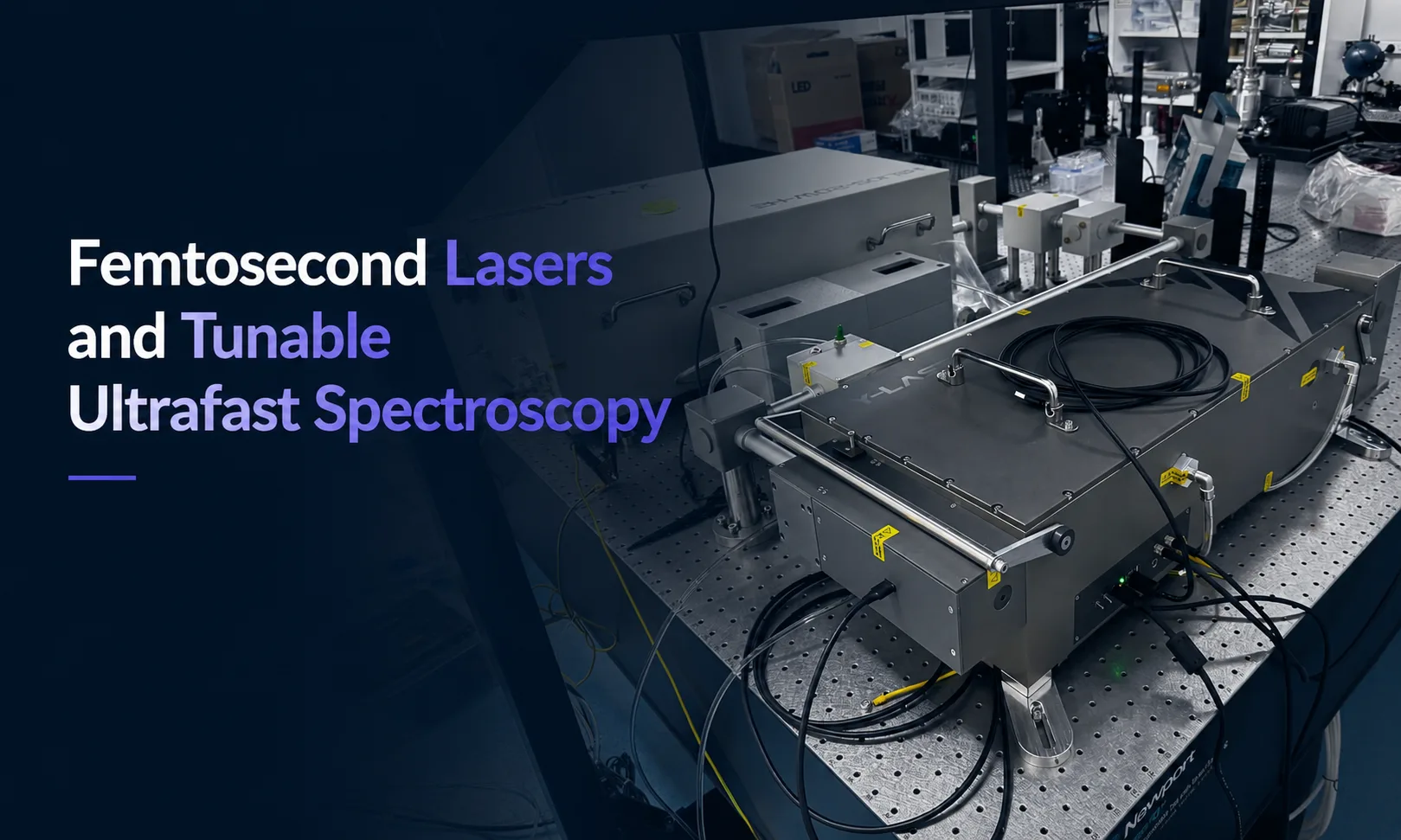
Lead: 2.16 mJ / 230.5 fs / 0.145 % RMS @ 24 h master + a 315 – 2600 nm tunable OPA + SHG — one integrated system covers every ultrafast-spectroscopy experiment across the UV, visible, NIR, and SWIR bands.
Industrial 1030 nm Yb femtosecond lasers have become the last decade's de-facto standard for high-power ultrafast platforms. Yet on the lab bench, the master's fixed 1030 nm output is, for almost every ultrafast-spectroscopy sample, just a starting point. Perovskite thin films absorb in 500 – 800 nm; 2D-material TMD excitons sit at 600 – 700 nm; organic-photovoltaic charge-transfer states extend across 800 – 1500 nm; π-π* electronic transitions at catalytic interfaces live in the 315 – 450 nm UV. Every class of sample demands that the driver "change color."
Y-LASER has recently delivered a complete tunable femtosecond source — a HELIOS-20W-HE high-energy master laser (serial YLM240702001) paired with an AURORA-HE femtosecond OPA (serial YLM250201002, with an integrated SHG module) — to an ultrafast-spectroscopy and new-energy-materials group. Pumped at 3.3 kHz / 1.5 mJ, the system delivers: Signal 630 – 1030 nm and Idler 1030 – 2600 nm continuous tuning; peak Signal 460 mW at 660 nm (9.2 % conversion), peak Idler 288 mW at 1100 nm (5.76 %); SHG extension to 315 – 630 nm UV; 24-hour master power stability of 0.145 % RMS and 24-hour OPA power stability of 0.6623 % RMS. One integrated system replaces what previously required a rack of dedicated lasers across the visible, UV, NIR, and SWIR.

HELIOS-20W-HE + AURORA-HE with integrated SHG module — customer bench, on-site commissioning (Newport SmartTable breadboard)
1. The physics: bridging 1030 nm to 315 – 2600 nm
The Yb gain medium's bandwidth (5 – 10 THz) pins the direct output near 1030 ± 20 nm. "Changing color" is fundamentally a frequency-translation problem: split the pump photon ω_p into a signal ω_s and an idler ω_i, or merge two pump photons into a single higher-energy 2ω_p harmonic. The first process is optical parametric amplification (OPA); the second is second-harmonic generation (SHG). Combined, they translate a single 1030 nm output into the full 315 – 2600 nm range — enough to cover the absorption bands of nearly every condensed-matter ultrafast experiment.
1.1 OPA: energy conservation + phase matching
In a nonlinear crystal (BBO / LBO / KTA), a high-energy pump ω_p undergoes parametric down-conversion into a signal ω_s and an idler ω_i. Both energy conservation (ω_p = ω_s + ω_i) and momentum conservation (k_p = k_s + k_i) are enforced. Rotating the crystal angle changes the phase-matching condition, tuning ω_s continuously across 630 – 1030 nm; ω_i then follows automatically via energy conservation, covering 1030 – 2600 nm.
1.2 SHG: extending down to 315 – 630 nm
SHG is the most elementary χ⁽²⁾ process: two fundamental photons at ω merge into one harmonic photon at 2ω, halving the wavelength. Doubling the OPA's 630 – 1030 nm signal arm yields 315 – 515 nm; doubling the 1030 – 1260 nm segment of the idler yields 515 – 630 nm. With an integrated SHG stage, a single OPA + SHG assembly delivers six octaves of continuous tunability from 315 nm to 2600 nm.
2. Hard specs the tunable-source chain must meet
Ultrafast spectroscopy places multi-dimensional demands on the master + OPA + SHG chain. The table below lists seven hard specs against measured values for this HELIOS-20W-HE + AURORA-HE delivery — all seven met, most cleared with substantial margin.

3. HELIOS-20W-HE master laser: factory acceptance data
HELIOS-20W-HE is built on an all-solid-state Yb CPA architecture (regenerative amplifier + multi-pass amplifier + integrated single-shot to 100 kHz pulse picker), diode-pumped throughout. The factory acceptance report (serial YLM240702001) covers four repetition-rate operating points: 3.3 / 10 / 50 / 100 kHz.

3.1 HELIOS 10 kHz output spectrum: 1036 nm centered, stable across rep rates
At the 10 kHz operating point, HELIOS delivers an output spectrum centered at 1036.3 nm with a near-symmetric Gaussian envelope — no mode beating, no visible sidebands. Across all four rep rates (3.3 / 10 / 50 / 100 kHz), the center wavelength holds between 1036.2 and 1036.7 nm, confirming that the seed source, multi-pass amplifier, and pulse picker are operating in a well-integrated regime with no secondary-mode structure. The spectrum below is captured on a YOKOGAWA AQ6370B high-resolution optical spectrum analyzer.
3.2 HELIOS 10 kHz autocorrelation: 230.5 fs FWHM
At the 10 kHz main operating point the pulse FWHM is 230.5 fs; at 50 and 100 kHz it broadens slightly to 255 – 258 fs, the expected thermal-equilibrium behavior of an Yb amplifier chain at high rep rate and already an industrial-tier result. 230.5 fs sits squarely in the OPA-pumping sweet spot — short enough to deliver high peak intensity and gain inside BBO, long enough to stay comfortably below the nonlinear damage threshold. The autocorrelation trace below shows the pulse envelope at the main operating point (PulseCheck NX S09706 autocorrelator).
 |  |
HELIOS-20W-HE 10 kHz output spectrum · center 1036.3 nm (YOKOGAWA AQ6370B) | HELIOS-20W-HE 10 kHz autocorrelation · 230.5 fs FWHM (PulseCheck NX S09706) |
3.3 HELIOS 24-hour long-term power stability: 0.145 % RMS
Continuous 24-hour burn-in at the 10 kHz operating point with 21.6 W average power yielded a power stability of 0.145 % RMS (60F-DC-25U S/N:23101857 thermal head, 30-minute warm-up). This places HELIOS-20W-HE in the top tier of mJ-class Yb femtosecond platforms — even after the OPA amplifies input noise across multiple stages, output stability comfortably stays below 0.7 % RMS. The 24-hour trace below runs essentially flat, with no visible thermal drift — the single most important engineering metric for a laser being used as a TA pump.
3.4 HELIOS 24-hour pointing stability: 7.87 µrad
Continuous 24-hour monitoring under F = 500 mm focusing yielded a centroid RMS of 3.93 µm, corresponding to 7.87 µrad of far-field pointing stability. For a downstream OPA, pointing drift on the order of 10 µrad is already enough to alter the effective phase-matching length inside the BBO crystal, shifting output energy and spectral shape. 7.87 µrad essentially eliminates any passive-drift contribution to downstream OPA/SHG conversion efficiency. The plot below tracks X- and Y-centroid position over the 24-hour window.
 |  |
HELIOS-20W-HE 24-hour long-term power stability · 21.6 W mean · RMS = 0.145 % (60F-DC-25U S/N:23101857) | HELIOS-20W-HE 24-hour pointing stability · F=500 mm focusing · centroid RMS = 3.93 µm · 7.87 µrad (WinCamD-LCM profiler) |
4. AURORA-HE OPA + SHG: factory acceptance data
AURORA-HE uses a white-light-seed + multi-stage BBO parametric amplification + SHG frequency-doubling architecture, pumped by the master's 10 kHz output divided down to 3.3 kHz / 1.5 mJ inside the pulse-picker stage. The acceptance report (serial YLM250201002) covers full Signal + Idler tuning, SHG UV extension, pulse duration, and 24-hour stability. The complete AURORA-HE package delivers 315 – 2600 nm continuous tunable femtosecond output.
4.1 Signal + Idler tuning across 630 – 2600 nm
Measured Signal output tunes continuously from 630 to 1030 nm; Idler from 1030 to 2600 nm — a single OPA can hop across the near-UV, visible, near-IR and SWIR ranges without any hardware swap. The tuning curve below shows both arms' power distribution: Signal peaks at 460 mW at 660 nm (9.2 % conversion) and holds ≥ 380 mW across 630 – 900 nm; Idler peaks at 288 mW at 1100 nm (5.76 % conversion) and holds ≥ 170 mW across 1100 – 1700 nm (CaiHuang 10F-MA-19U thermal head).
 | |
AURORA-HE Signal + Idler tuning curve · 3.3 kHz / 1.5 mJ injection · Signal peak 460 mW @ 660 nm (9.2 %) · Idler peak 288 mW @ 1100 nm (5.76 %) (CaiHuang 10F-MA-19U) |
4.2 Signal-arm spectral quality across the full tuning range
The composite plot below overlays the AURORA-HE Signal spectrum at every 10 – 20 nm tuning step from 630 to 1030 nm — each colored trace is an individual operating point. The envelope is smooth, peak amplitudes are uniform, and neighboring tuning points produce no visible spectral distortion. This kind of spectral consistency is the physical prerequisite for "every tuning point can drop directly into the downstream TA experiment with no re-alignment" — and it is also one of the cleanest indicators of how mature an OPA's engineering really is (RuHai XS11639 spectrometer).
4.3 Idler-arm spectral quality across the full tuning range
The composite plot below shows the Idler spectrum at every 50 – 100 nm tuning step from 1030 to 2600 nm — covering both NIR and SWIR bands, which supports organic-photovoltaic CT-state dynamics (1200 – 1500 nm), semiconductor inter-band transitions (1500 – 2000 nm), and quantum-dot inter-band absorption (1.2 – 2.5 µm) directly (FuXiang NIR25S + RuHai F40091400 spectrometers combined).
 |  |
AURORA-HE Signal-arm output spectra across the full continuous tuning range (630 – 1030 nm, RuHai XS11639 spectrometer) | AURORA-HE Idler-arm output spectra across the full continuous tuning range (1030 – 2600 nm, FuXiang NIR25S + RuHai F40091400) |
4.4 AURORA-HE 750 nm autocorrelation: 175.3 fs FWHM
At the 750 nm operating point AURORA-HE delivers 175.3 fs FWHM output pulse duration — comfortably inside the 120 – 250 fs specification window. Compared to the 230.5 fs master pulse, the OPA output is actually shorter — a signature of the nonlinear time-domain compression that OPA parametric amplification produces, and a critical feature for preserving femtosecond time resolution downstream. The autocorrelation trace below shows the pulse envelope at the 750 nm main operating point (Pulsecheck NX 50 autocorrelator).
4.5 AURORA-HE 24-hour long-term power stability: 0.6623 % RMS
Continuous 24-hour monitoring at the 750 nm operating point with 398 mW average power gave a power stability of 0.6623 % RMS (CaiHuang 10F-MA-19U thermal head) — comfortably 3× better than the < 2 % RMS specification. For ultrafast spectroscopy, this level of OPA stability sets the noise floor of the TA differential signal — and the lower that floor, the faster publication-quality data can be acquired. 0.6623 % RMS at 24 hours means a single-scan SNR that a more typical 1 %-class OPA would require roughly 2.3 averaged scans to match. The curve below runs essentially flat over the full 24-hour window.
 |  |
AURORA-HE 750 nm autocorrelation · 175.3 fs FWHM (Pulsecheck NX 50) | AURORA-HE 24-hour long-term power stability at 750 nm · 398 mW mean · RMS = 0.6623 % (CaiHuang 10F-MA-19U · reconstructed from acceptance-report RMS = 0.6623 %) |
4.6 Full AURORA-HE + SHG acceptance summary

5. Four classes of ultrafast experiments unlocked by one system
On a single bench, HELIOS-20W-HE + AURORA-HE + SHG supports four distinct experimental modes simultaneously:
Mode A: UV-Vis TA pump-probe (315 – 630 nm via SHG)
The SHG module extends into 315 – 515 nm deep UV and 515 – 630 nm visible — covering aromatic π-π* transitions, MLCT bands, and the critical UV absorption windows of catalytic intermediates. 0.66 % RMS / 24-hour stability translates directly into a lower TA differential-signal baseline.
Mode B: Vis-NIR TA pump-probe (630 – 1030 nm)
The Signal arm covers 630 – 1030 nm directly — matching perovskite band edges, TMD exciton peaks, and semiconductor quantum-dot absorption bands. 460 mW peak at 660 nm delivers ample photon flux; 175.3 fs pulse duration preserves femtosecond-level time resolution.
Mode C: SWIR ultrafast spectroscopy (1030 – 2600 nm)
The Idler arm covers the SWIR directly — supporting organic-photovoltaic CT-state dynamics, semiconductor inter-band transitions, and quantum-dot inter-band absorption. 288 mW peak at 1100 nm meets typical SWIR-band probing power requirements.
Mode D: high-repetition-rate fast scanning (100 kHz TA sweep)
Via the integrated pulse picker, the master can switch to a 100 kHz operating point (216 µJ / 21.6 W), driving a white-light continuum or high-rep-rate fast-scan TA / materials screening directly. One master, one optical bench, seamless switching between "3.3 kHz high-energy OPA pumping" and "100 kHz high-rep-rate fast scanning."
Four modes — one master, one OPA + SHG, one optical bench. This is what an industrial Yb femtosecond platform looks like once it has evolved into a fully integrated tunable ultrafast-spectroscopy benchtop.
6. Closing thought
2.16 mJ, 230.5 fs, 0.145 % RMS @ 24 h, 9.2 % Signal peak, 5.76 % Idler peak, 315 – 2600 nm full tuning, 0.6623 % RMS @ 24 h — these seven HELIOS-20W-HE + AURORA-HE numbers map cleanly onto the seven physical dimensions a tunable ultrafast-spectroscopy chain must satisfy: energy threshold, pulse-duration sweet spot, master stability, Signal conversion, Idler conversion, spectral coverage, and OPA long-term stability.
The engineering value of "master + OPA + SHG" as an integrated delivery reaches well beyond convenience — it lets key metrics be systemically co-optimized across the entire chain. The master's 0.145 % RMS stability transfers cleanly through to the OPA output's 0.6623 % RMS, directly compressing the TA differential-signal baseline. SHG polarization and phase matching are calibrated relative to the OPA at the factory, avoiding the conversion-efficiency losses that separately sourced third-party SHG stages routinely introduce.