Femtosecond Lasers and Ultrafast Spectroscopy — Optical Parametric Amplifiers (OPAs): Giving a 1030 nm Yb Master "Any Color It Needs"
HELIOS-40W-HP、HYPERION-G-HE、Femtosecond Laser、MPC、Few Cycle、Pulse Compression、HHG 、EUV、、Attosecond、TRARPES、Strong Field Physics、Ultrafast Photonics
July 28, 2026
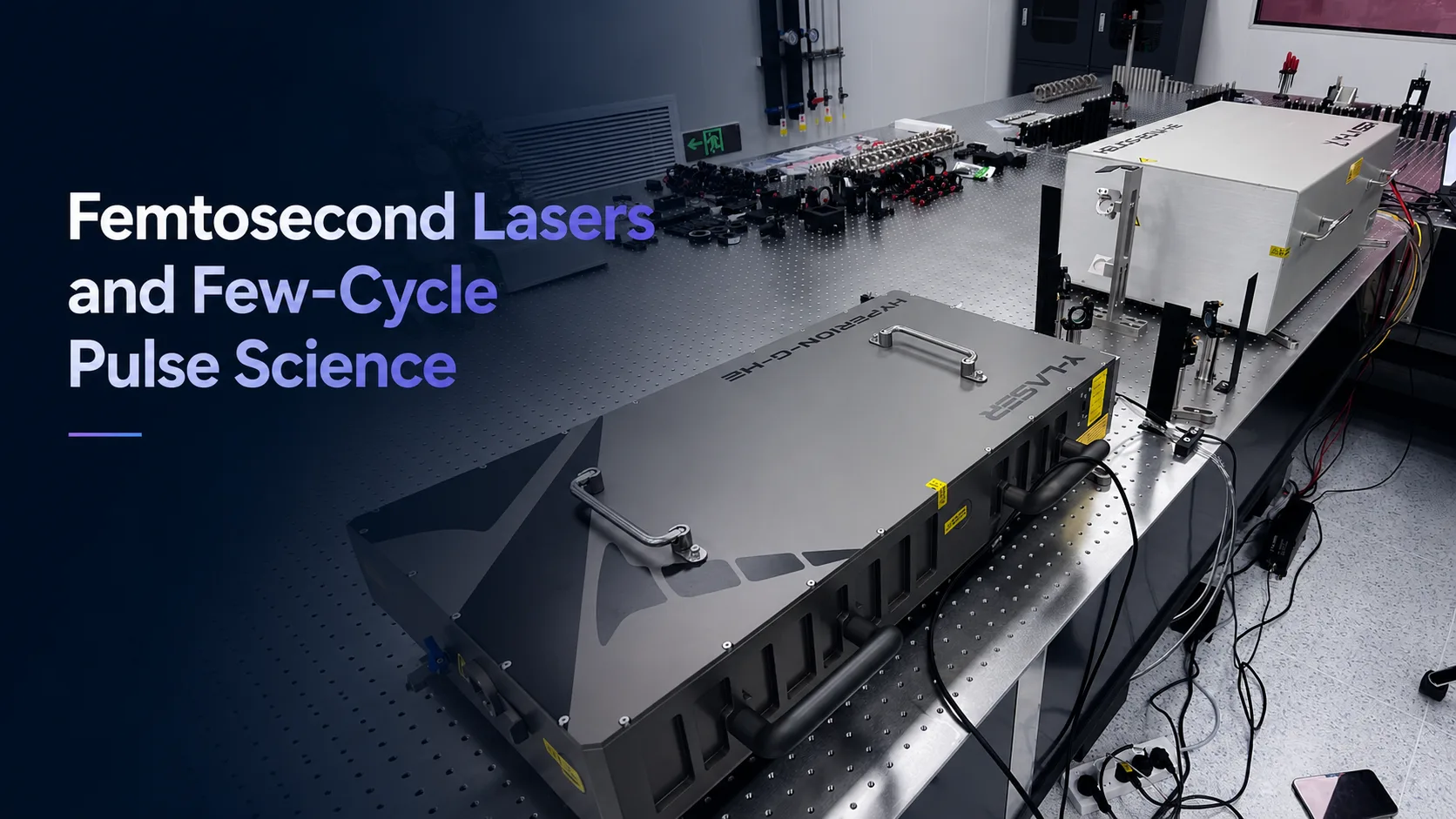
Lead: 217.5 fs → 36.2 fs / 6× compression / 95 % transmission / 10.5 GW peak power / 100 kHz repetition rate — one 40 W-class Yb master plus one multi-pass cell brings high-harmonic generation and EUV coherent-source physics into a mainstream benchtop.
Over the past decade, industrial Yb femtosecond lasers have delivered on "more stable": sub-0.1 % RMS long-term power stability and 24/7 industrial reliability. The next decade is unfolding along two simultaneous directions: "shorter" (few-cycle pulses, sub-50 fs down toward sub-10 fs) and "higher repetition rate × higher average power" (100 kHz to MHz, tens to hundreds of watts). Where these two directions intersect lives the entire next generation of ultrafast physics — high-harmonic generation (HHG), EUV and VUV coherent sources, attosecond streaking, time-resolved photoelectron spectroscopy (TR-ARPES) — almost all of which demand pulse durations below 50 fs, peak power above 5 GW, and average power above 20 W.
Y-LASER has recently delivered a complete high-repetition-rate few-cycle femtosecond source — a HELIOS-40W-HP high-power master laser paired with a HYPERION-G-HE multi-pass cell (MPC) nonlinear pulse compressor — to an ultrafast-laser and strong-field-physics research group. HELIOS-40W-HP delivers 43.8 W / 217.5 fs / 438 µJ at 100 kHz, with 24-hour long-term power stability of 0.03 % RMS and pointing stability of 0.908 µrad. After the HYPERION-G-HE stage, output pulse duration compresses to 36.2 fs while retaining 380 µJ of single-pulse energy at 95 % transmission; the −10 dB spectrum broadens from 15 nm to 83 nm; peak power climbs from 1.84 GW to 10.5 GW. In one commissioning run, the whole chain shows that "40 W-class 100 kHz few-cycle femtosecond driver" is now ready for mainstream HHG and attoscience deployment.
1. The physics: high-repetition-rate few-cycle femtosecond in one paragraph
The Yb gain medium's bandwidth (5 – 10 THz) pins direct output near 200 fs. To break through, the industry has converged on multi-pass cell (MPC) post-compression: the femtosecond pulse enters a Herriott-type reflective cavity filled with a few bar of noble gas (Ar / Kr / He), makes 30 – 60 passes accumulating self-phase modulation (SPM) that symmetrically broadens the spectrum by 5 – 10×, then exits into a chirped-mirror set that supplies the opposite group-delay dispersion (GDD) and recompresses the pulse back toward the transform limit.
MPC's three engineering advantages over other post-compression approaches (fiber broadening, single-pass gas cells, bulk solid-state):
■ Power and energy headroom: a reflective cavity with a large mode area avoids the damage thresholds that cap fiber-based broadening; MPCs comfortably handle mJ pulses and 100+ W average power;
■ Spatial-mode preservation: Herriott multi-pass geometry keeps a Gaussian transverse mode — output M² stays close to input M², with no need for downstream beam shaping;
■ Noise transparency: mirrors and gas add essentially no phase noise — a 0.03 % RMS master transfers to a 0.06 %-class output almost intact.
The engineering value of 100 kHz repetition rate is statistics: relative to a traditional 1 – 10 kHz drive, data acquisition compresses by 1/10 – 1/100. Parameter sweeps that used to take a week can now finish in a day. This is the condition that turns HHG / TR-ARPES from "demo experiments" into "engineered workflows."
2. Hard specs the high-rep-rate few-cycle driver chain must meet
The table below lists seven hard specs the master + MPC chain must meet, against measured values from this delivery — all met, most with substantial margin.

3. HELIOS-40W-HP master laser: factory acceptance data

HELIOS-40W-HP is built on an all-solid-state Yb CPA architecture (regenerative amplifier + multi-pass amplifier + integrated single-shot to 100 kHz pulse picker), diode-pumped throughout. Factory acceptance covers two operating points: 100 kHz for MPC-drive service and 1 MHz for high-statistics acquisition-intensive experiments (TR-ARPES, PEEM).

3.1 HELIOS-40W-HP 100 kHz output spectrum: 1034.9 nm centered
At the 100 kHz operating point HELIOS-40W-HP delivers a spectrum centered at 1034.9 nm, near-symmetric Gaussian, with no visible mode beating or sidebands. At 1 MHz the center wavelength holds at 1035.3 nm — < 0.5 nm shift across two orders of magnitude in rep rate, confirming that the seed source, multi-pass amplifier and pulse picker all operate in a well-integrated regime. The spectrum below is captured on a YOKOGAWA AQ6370B high-resolution optical spectrum analyzer.
3.2 HELIOS-40W-HP 100 kHz autocorrelation: 217.5 fs FWHM
At the 100 kHz main operating point the pulse FWHM is 217.5 fs; at 1 MHz it broadens slightly to 226.2 fs, the typical thermal-equilibrium behavior of an Yb amplifier chain at high rep rate. 217.5 fs sits squarely in the MPC-pumping sweet spot — the dispersion position (23.9 mm inside the amplifier) is tuned to provide adequate SPM interaction length inside the cell. The autocorrelation trace below shows the pulse envelope at the main operating point (PulseCheck NX S09706 autocorrelator).
 |  |
HELIOS-40W-HP 100 kHz output spectrum · center 1034.9 nm (YOKOGAWA AQ6370B) | HELIOS-40W-HP 100 kHz autocorrelation · 217.5 fs FWHM (PulseCheck NX S09706) |
3.3 HELIOS-40W-HP 24-hour long-term power stability: 0.03 % RMS
Continuous 24-hour burn-in at the 1 MHz operating point (44.62 W average, 1-hour warm-up) yielded a power stability of 0.03 % RMS (PM USB PM150-50C thermal head). This is the top tier of 40 W-class Yb femtosecond platforms, typically an order of magnitude better than the industrial-standard benchmark. 0.03 % RMS at the master translates to below 0.1 % RMS at the MPC output — the physical foundation for a "noise-below-signal" baseline in downstream HHG / EUV long-integration experiments. The 24-hour trace below runs essentially flat, with no visible thermal drift.
3.4 HELIOS-40W-HP 24-hour pointing stability: 0.908 µrad
Continuous 24-hour monitoring under F = 500 mm focusing yielded a centroid RMS of 0.454 µm, corresponding to 0.908 µrad of far-field pointing stability — sub-µrad, top of the class. For a downstream MPC, master pointing drift directly determines the intracavity energy deposition pattern; 0.9 µrad essentially locks the interaction volume in place, so output pulse duration and beam profile do not drift with the master. The plot below tracks X- and Y-centroid position over the 24-hour window (LT-500-VIS-NIR-HQ profiler).
 |  |
HELIOS-40W-HP 24-hour long-term power stability · 44.62 W mean · RMS = 0.03 % (PM USB PM150-50C · reconstructed from acceptance-report RMS = 0.03 %) | HELIOS-40W-HP 24-hour pointing stability · F=500 mm focusing · centroid RMS = 0.454 µm · 0.908 µrad (LT-500-VIS-NIR-HQ · reconstructed from acceptance-report RMS = 0.454 µm) |
4. HYPERION-G-HE multi-pass cell: factory acceptance data
HYPERION-G-HE uses a Herriott-type reflective multi-pass cell filled with noble gas, paired with a custom chirped-mirror set for GDD compensation. Acceptance test shows the complete input-output chain: input 40 W / 400 µJ / 217.5 fs at 100 kHz; output 38 W / 380 µJ / 36.2 fs at 100 kHz — 6× compression, 95 % transmission, 5.5× spectral broadening, and a 5.7× peak-power gain.

4.1 MPC input vs. output spectrum: 15 nm → 83 nm (5.5× broadening)
The 1030 nm input entered the cell with a −10 dB bandwidth of 15 nm; SPM inside the noble-gas cell broadened the output −10 dB bandwidth to 83 nm — enough transform-limit-equivalent bandwidth to support 36 fs pulse duration. The spectrum below overlays input and output — the broadened output shows the classic multi-peak SPM modulation structure across the 1000 – 1080 nm range (RuHai L/300-1100 spectrometer).
4.2 MPC input vs. output pulse duration: 217.5 fs → 36.2 fs (6× compression)
Measured output pulse FWHM was 36.2 fs by Sech² fit of the autocorrelation (PulseCheck-S11030 autocorrelator). Compared to the 217.5 fs / 400 µJ input, that's a 6.0× compression — clearing the sub-40 fs threshold and entering the working regime for few-cycle femtosecond science. The autocorrelation below places the input and output envelopes side by side; the 36.2 fs output pulse presents a clean, narrow-peak temporal profile.
 |  |
HYPERION-G-HE MPC input vs. output spectrum · input −10 dB bandwidth 15 nm → output 83 nm (RuHai L/300-1100) | HYPERION-G-HE MPC input (217.5 fs) vs. output (36.2 fs) autocorrelation · 6× compression (PulseCheck-S11030) |
4.3 MPC energy and peak power
■ Output power / single-pulse energy: 38 W / 380 µJ at 100 kHz
■ Overall transmission: 95 % (400 µJ in → 380 µJ out — almost nothing is lost)
■ Input-side peak power: 400 µJ ÷ 217.5 fs ≈ 1.84 GW
■ Output-side peak power: 380 µJ ÷ 36.2 fs ≈ 10.5 GW
■ Peak-power gain ≈ 5.7× — "free gain at the same energy budget," and arguably the most important engineering advantage MPC has over alternative compression schemes
4.4 MPC 24-hour long-term power stability: 0.064 % RMS
Continuous 24-hour monitoring at 38 W average power gave a power stability of 0.064 % RMS (PM USB PM150-50C thermal head) — the top tier for 100 kHz / 40 W-class MPC output, roughly 3 – 8× better than mainstream MPCs in the same power class (which typically sit at 0.2 – 0.5 % RMS). 0.064 % RMS means the MPC output can drive HHG long-integration experiments directly, with no active power-lock feedback required. The trace below runs essentially flat over the full 24-hour window.
4.5 MPC 24-hour pointing stability: 6.79 µrad
Continuous 24-hour monitoring under F = 450 mm focusing yielded a centroid RMS of 3.05 µm at the MPC exit, corresponding to 6.79 µrad of far-field pointing stability. For downstream HHG, MPC exit pointing directly sets the focal-spot position stability at the gas target — 6.79 µrad ensures the spatial stability of the HHG harmonic signal. The plot below tracks X- and Y-centroid position over the 24-hour window (Dataray-WinCamD-LCM profiler).
 |  |
HYPERION-G-HE MPC 24-hour long-term power stability · 38 W mean · RMS = 0.064 % (PM USB PM150-50C · reconstructed from acceptance-report RMS = 0.064 %) | HYPERION-G-HE MPC 24-hour pointing stability · F=450 mm focusing · centroid RMS = 3.05 µm · 6.79 µrad (Dataray-WinCamD-LCM · reconstructed from acceptance-report RMS = 3.05 µm) |
4.6 Full MPC acceptance summary

5. Four experimental modes unlocked by one system
On a single bench, HELIOS-40W-HP + HYPERION-G-HE MPC supports four distinct ultrafast experimental modes simultaneously:
Mode A: high-harmonic generation and EUV coherent sources
10.5 GW peak / 36 fs / 100 kHz drive focused onto a gas target raises the HHG cut-off energy E_cutoff ≈ I_p + 3.17 × U_p significantly under sub-40 fs drive; 100 kHz rep rate lifts single-photon flux to the 10¹¹ – 10¹² photons/s range — the parameter recipe that turns EUV coherent diffractive imaging (CDI) from a demonstration into a routine measurement.
Mode B: attoscience and attosecond streaking
36 fs / 380 µJ / 100 kHz drive paired with HHG can produce isolated attosecond pulses; the 100 kHz repetition rate delivers the statistics and short acquisition times attosecond streaking and attosecond TA experiments have always demanded; 24-hour 0.064 % RMS power stability meets the coherent long-integration requirements of attoscience.
Mode C: time-resolved photoelectron spectroscopy (TR-ARPES / TR-PEEM)
At the 1 MHz operating point the master drives an XUV source that compresses TR-ARPES data-acquisition time from days to hours; simultaneously, the 100 kHz high-peak path supports the high-flux imaging modes required for XUV photoemission electron microscopy (PEEM) — one system, two lines.
Mode D: strong-field physics and ultrafast electron diffraction
10.5 GW peak power focused into a ~10 µm spot reaches the 10¹⁴ – 10¹⁵ W/cm² regime — enough to drive strong-field ionization, ultrafast electron diffraction (UED), and solid-state HHG (sHHG) experiments; near-diffraction-limited M² guarantees the focusability those experiments require.
Four modes — one master, one MPC, one optical bench. This is what an industrial Yb femtosecond platform looks like once it has evolved into a benchtop infrastructure for attoscience and EUV physics.
6. Closing thought
43.8 W, 217.5 fs, 0.03 % RMS @ 24 h, 0.908 µrad @ 24 h, 38 W, 36.2 fs, 95 % transmission, 10.5 GW peak, 0.064 % RMS @ 24 h — these nine HELIOS-40W-HP + HYPERION-G-HE MPC numbers map cleanly onto the nine physical dimensions a high-rep-rate few-cycle driver must satisfy for HHG / EUV work: master average power, master pulse duration, master stability, master pointing, MPC output power, MPC output pulse duration, energy-transfer efficiency, peak power, and MPC long-term stability. Miss any one and the chain loses the engineering margin to drive HHG long-integration experiments.
Industrial Yb femtosecond lasers should not be confined to 200 fs, and MPC post-compression should not be treated as a nice-to-have accessory. Together they form the standard infrastructure for the next generation of high-repetition-rate few-cycle femtosecond sources. This engineering demonstration — 6× compression, 95 % transmission, 10.5 GW peak power, 100 kHz repetition — is the quantitative evidence: the mJ-µJ-class Yb + MPC post-compression combination has now matured into a platform ready for mainstream HHG, EUV, and attosecond deployment.