How a Compact Femtosecond Laser Pushes TAS Differential Signals Into the 10⁻⁴ ΔA Regime
HELIOS-20W-HP、Femtosecond Laser、Yb Laser、Compact Laser、Ultrafast Spectroscopy、Transient Absorption、Pump Probe、TAS、TRPL、Photonics
September 4, 2026
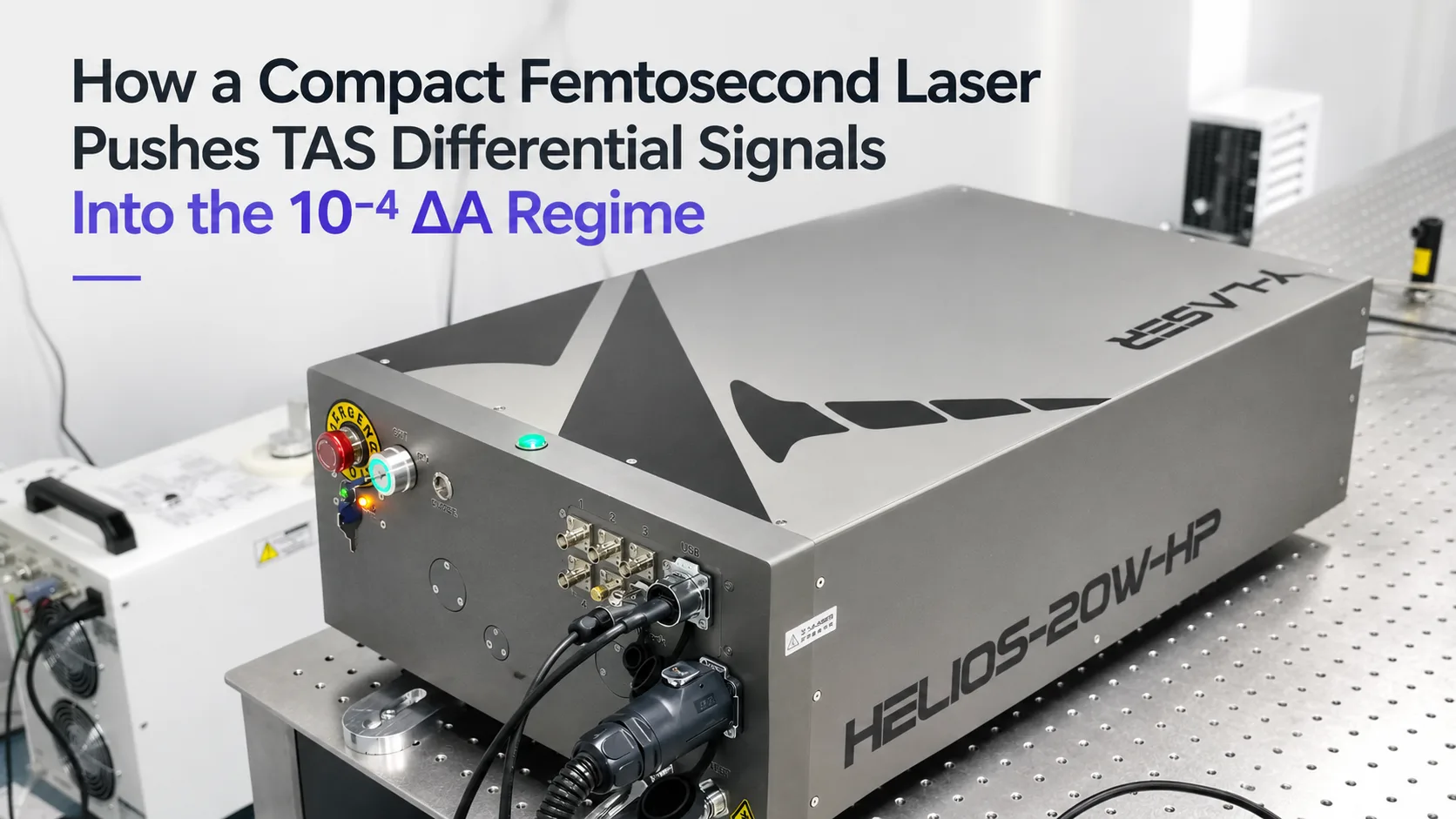
A compact femtosecond laser purpose-engineered for Transient Absorption Spectroscopy (TAS) and pump-probe ultrafast dynamics. HELIOS-20W-HP has all three rep-rates (50 / 100 / 200 kHz) plus a 25 kHz add-on working point factory-validated. Its 24 h power stability of 0.07 % RMS drops the TAS ΔA / ΔT baseline noise floor into the 10⁻⁴ regime, and its 4.56 μrad pointing keeps pump-probe spatial overlap at the physical limit.
1 · What Is Transient Absorption Spectroscopy? (60-second primer)
Transient Absorption Spectroscopy (TAS) is the workhorse technique for tracking how excited electrons and excitons evolve on the femtosecond-to-nanosecond timescale after photoexcitation. It has three moves:
▪ ▶ Pump — a femtosecond "pump" pulse promotes the sample from its ground state to an excited state.
▪ ▶ Probe — a delayed "probe" pulse measures how the sample absorption changes with time, ΔA(λ, τ).
▪ ▶ Decode — the temporal evolution of ΔA(λ, τ) reveals the underlying charge transfer, exciton formation, carrier cooling, and related ultrafast processes.
The catch is that a typical TAS signal ΔA sits at 10⁻³ – 10⁻⁴ — three to four orders of magnitude below the background absorption. Seeing that signal is not about how sensitive your detector is; it is about how stable your laser is. Any 0.5 %-level power drift, or any 10 μrad-level pointing jitter, will drown the real dynamics in system noise.
So the TAS requirement on a femtosecond laser reduces to one word: stability.
2 · Six spec-sheet gates for a TAS-ready femtosecond laser
▪ High single-pulse energy — the pump arm needs μJ-class energy to drive OPA / SHG for wavelength-tunable pumping; the probe arm needs enough energy to drive a stable white-light continuum (WLC) for broadband probing.
▪ Multi-rate flexibility — low rep-rates (20 – 50 kHz) match sample thermal recovery; high rep-rates (100 – 200 kHz) chase acquisition speed and SNR; one laser has to serve both modes.
▪ Extreme long-term stability — with TAS signals at 10⁻³ – 10⁻⁴, any 0.5 %-level power drift buries real dynamics. The industry needs 24 h stability better than 0.1 % RMS.
▪ Low pointing jitter — pump-probe spatial overlap at the sample is what makes a TAS signal measurable at all. Pointing > 10 μrad translates into μm-level walk-off over a 30 – 50 cm beam path, and overlap drifts with time.
▪ Clean beam quality — M² close to the diffraction limit (< 1.15) is what keeps OPA / SHG conversion efficient and WLC generation reliable.
▪ High pre-pulse contrast — any pre-pulse pre-excites the sample and scrambles the ground-to-excited-state dynamics. ≥ 1000:1 is the gating spec for a serious TAS platform.
HELIOS-20W-HP is engineered against exactly these six gates.
3 · Highlights at a Glance
Highlight | Value / Detail |
Product | Y-LASER HELIOS-20W-HP · Compact Femtosecond Laser for TAS / Pump-Probe platforms |
Architecture | 1030 nm Yb-doped CPA · DPSSL pumped · water-cooled · single-box design |
Rep-rate options | 50 kHz / 434 μJ | 100 kHz / 216 μJ | 200 kHz / 108 μJ — all factory-validated |
Additional working point | 25 kHz / 432 μJ / 10.8 W (low-rep-rate mode for long-lifetime luminescent samples) |
Pulse duration (FWHM) | 183.6 fs @ 50 kHz · 187.2 fs @ 100 kHz · 189.1 fs @ 200 kHz |
Main output | 21.8 W / 434 μJ @ 50 kHz · Peak power 2.36 GW |
24 h power stability | 0.07 % RMS ★ |
24 h pointing stability | 4.56 μrad |
Beam quality M² | < 1.11 across all rep-rates · Near-field 5.20 – 5.33 mm · Linear polarization |
Pre-pulse contrast | 1000 : 1 (meets TAS platform gating spec) |
Mechanical / cooling | Beam height 72 mm · water-cooled · single-box |
4 · Why It Matters — the Data Speaks
■ Advantage 1 · Three rep-rate spectra fully overlap (λc 1038.2 – 1038.5 nm)
Output spectra at 50 / 100 / 200 kHz are nearly indistinguishable — center wavelengths sit at 1038.2 – 1038.5 nm, drift below 0.3 nm. Spectral shape is symmetric with a -10 dB bandwidth around 10 nm, corresponding to a Fourier-limited pulse of ~180 fs and matching the measured 183.6 – 189.1 fs. That match tells you the CPA phase compensation is right. In practice, that spectral consistency is what keeps downstream OPA / SHG efficiency and WLC generation reproducible whenever the operator swaps between rep-rates.
■ Advantage 2 · Pulse duration 183 – 189 fs · Peak power 2.36 GW
Measured autocorrelation across the three rep-rates: 183.6 fs / 187.2 fs / 189.1 fs — all inside 190 fs. Compare that with the 250 – 300 fs output typical of Yb-CPA amplifiers at similar energy, and HELIOS-20W-HP delivers a further 30 %+ compression at the same energy point. The autocorrelation traces are symmetric with no visible pedestal — a good sign that higher-order dispersion is compensated and the CPA stretch-compress leg is well balanced. The direct payoff: single-pulse peak power = single-pulse energy / pulse duration → 2.36 GW at the 50 kHz working point, more than enough to drive first-order OPA parametric amplification and to cross the WLC generation threshold with margin.
 |  |  |
Fig. 1 | HELIOS-20W-HP · Output Spectrum @ 50 kHz · λc = 1038.2 nm | Fig. 2 | HELIOS-20W-HP · Output Spectrum @ 100 kHz · λc = 1038.5 nm | Fig. 3 | HELIOS-20W-HP · Output Spectrum @ 200 kHz · λc = 1038.5 nm |
 |  |  |
Fig. 4 | HELIOS-20W-HP · Autocorrelation @ 50 kHz · 183.6 fs (FWHM) | Fig. 5 | HELIOS-20W-HP · Autocorrelation @ 100 kHz · 187.2 fs (FWHM) | Fig. 6 | HELIOS-20W-HP · Autocorrelation @ 200 kHz · 189.1 fs (FWHM) |
■ Advantage 3 · 24 h Power Stability: 0.07 % RMS ★ TAS-critical
50 kHz / 21.8 W main working point, monitored continuously for 24 h — power stability of 0.07 % RMS, roughly 7× tighter than the < 0.5 % industry-typical spec. That single number sets the TAS system noise floor: it drops the ΔA baseline into the 10⁻⁴ regime and stops laser drift from swallowing weak dynamics signals.
■ Advantage 4 · 24 h Pointing Stability: 4.56 μrad ★ physical floor for pump-probe overlap
Beam centroid RMS 2.28 μm at 500 mm focal length translates to a 24 h pointing stability of 4.56 μrad. Over a typical 30 – 50 cm pump-probe path, the sample-plane walk-off contributed by laser pointing stays under 3 μm — well below the 100 μm-class pump-probe spot size, so overlap does not drift day-to-day.
 |  |
Fig. 7 | HELIOS-20W-HP · 24 h Power Stability · 0.07 % RMS @ 21.8 W / 50 kHz | Fig. 8 | HELIOS-20W-HP · 24 h Pointing Stability · 4.56 μrad |
■ Advantage 5 · Three rep-rates + 25 kHz add-on — one laser covers the whole platform
All three rep-rates (50 / 100 / 200 kHz) pass factory acceptance, plus a 25 kHz add-on low-rep-rate working point (10.8 W / 432 μJ). One laser gives you both mJ-density experiments (TA pump + WLC generation) and hundred-μJ high-rep-rate acquisition (fast TAS / pump-probe scans), and stays compatible with long-lifetime luminescent samples for TR-PL. One purchase, no swapping heads, no re-aligning the beamline.
■ Advantage 6 · M² < 1.11 + 1000:1 pre-pulse contrast
Beam quality M² stays between 1.093 and 1.110 across all three rep-rates, close to the diffraction limit — enough head-room for efficient OPA / SHG conversion and consistent WLC generation. Pre-pulse contrast is 1000:1, which physically prevents "pre-excitation" from scrambling the ground-to-excited-state dynamics — the gating spec for any serious TAS or ultrafast spectroscopy platform.
■ Advantage 7 · Compact single-box design + all-solid-state Yb-CPA architecture
The full mJ-class CPA chain is integrated into a single water-cooled enclosure at 72 mm beam height — plug-and-play. Compared to the traditional "separate seed + pump + amplifier" multi-chassis approach, the footprint is smaller, the beam path is simpler, and day-to-day maintenance is lighter. This makes it a natural fit for space-limited but stability-critical ultrafast spectroscopy tables.
5 · Platforms this laser can drive as a shared source
▪ ▶ Transient Absorption Spectroscopy (TAS) · pump-probe — ΔA(λ, τ) measurements on perovskites, 2D materials, quantum dots, organic semiconductors.
▪ ▶ Ultrafast carrier dynamics — hot-carrier cooling, electron-phonon coupling, interfacial charge separation.
▪ ▶ Ultrafast charge transfer and excitonic dynamics — D-A charge transfer, exciton formation / coupling / dephasing.
▪ ▶ Photochemistry intermediate dynamics — femtosecond radical / transient intermediate formation and decay.
▪ ▶ Time-resolved photoluminescence (TR-PL) — 25 kHz add-on rate accommodates long-lifetime luminescent samples.
▪ ▶ High-stability driver for downstream OPA / SHG / WLC nonlinear stages.
6 · Closing Notes
183.6 fs · 21.8 W / 434 μJ · three rep-rates + a 25 kHz add-on · 24 h stability 0.07 % RMS · pointing 4.56 μrad · M² < 1.11 · pre-pulse contrast 1000:1 — the numbers Y-LASER HELIOS-20W-HP delivers cover every gate on the TAS specification checklist.
The point of a compact femtosecond laser acting as a shared driver for TAS + Pump-Probe + TR-PL is not just "meeting spec". It is pushing laser stability to the physical floor of the TAS platform — weak signals no longer buried by drift, spatial overlap no longer walking away with time, pre-pulses no longer scrambling the excited-state dynamics. That is what "the laser is no longer the bottleneck" actually means.