mJ-Class Femtosecond + OPA + MPC Sub-50 fs - Three Units Solving Two Physical Constraints
HELIOS-25W-HE、AURORA-H-HP、HYPERION-S、Femtosecond Laser、Yb Laser、OPA、MPC、Pulse Compression、Tunable Laser、Ultrafast Spectroscopy、Transient Absorption、Photonics
August 28, 2026
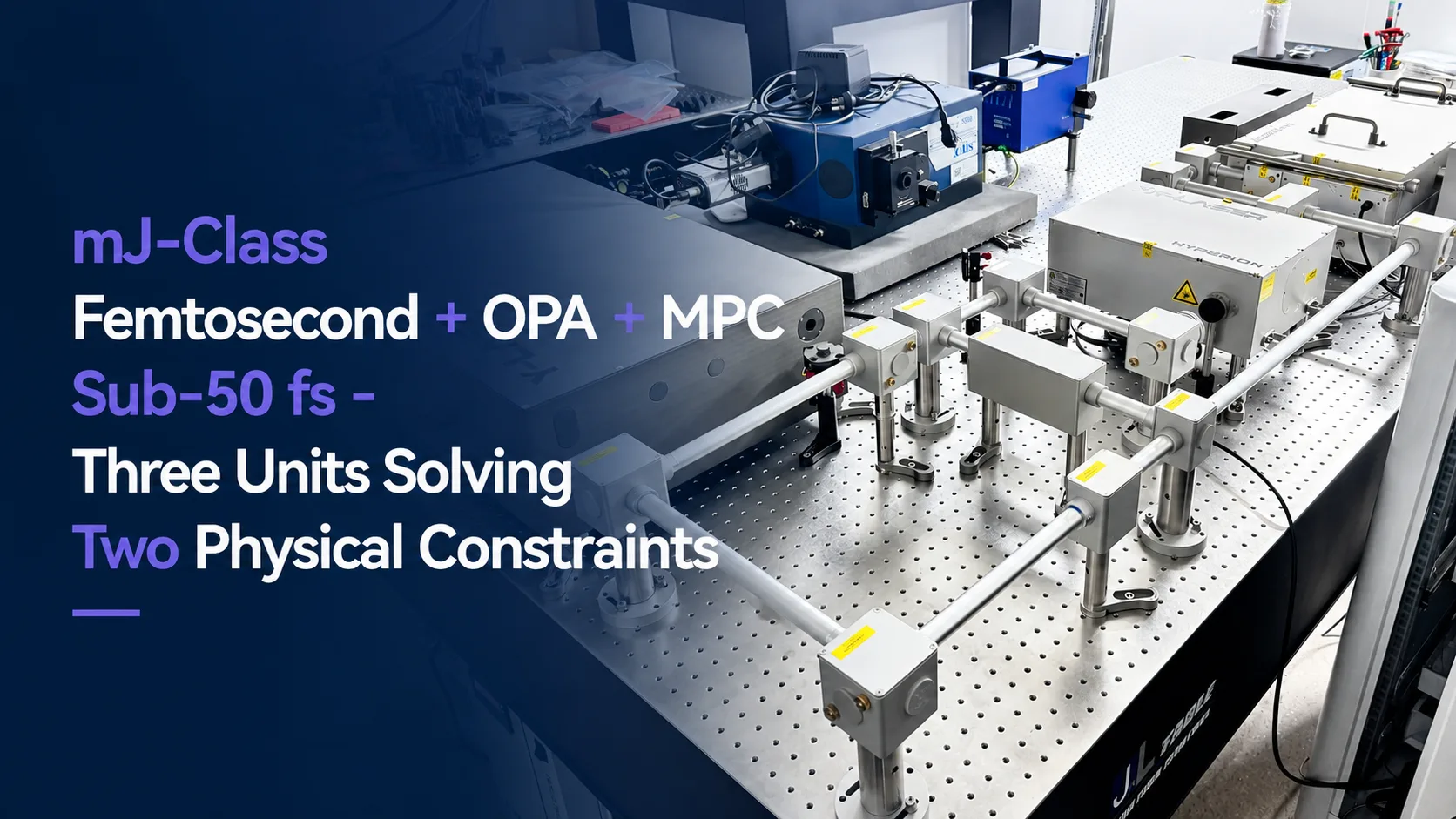
In ultrafast spectroscopy, wavelength and pulse duration are two parallel constraints. A 1030 nm Yb high-energy femtosecond laser provides the energy and stability backbone, but what actually lands on the sample is typically the tunable output after optical parametric amplification (OPA) — covering perovskite band edges, TMD excitonic transitions, organic charge-transfer (CT) states and quantum-dot interband absorption. And the ~200 – 250 fs pulses coming out of an OPA are still too long for ultrafast electron-phonon coupling, hot-carrier thermalization or photochemistry-intermediate dynamics — you need MPC pulse compression to bring them into the tens-of-femtoseconds regime and open a genuine sub-50 fs time-resolution window.
Y-LASER’s HELIOS-25W-HE + AURORA-H-HP OPA + HYPERION-S MPC — three coordinated units — is engineered exactly against this pair of constraints: one purchase solves both "wavelength tunability" and "sub-50 fs pulse duration" on a single bench, ready to plug straight into TA pump-probe experiments.
1 · Highlights at a Glance
Highlight | Value / Detail |
System | Y-LASER HELIOS-25W-HE + AURORA-H-HP OPA (with SCMP) + HYPERION-S standalone MPC (three-unit chain) |
Main laser | 1030 nm / 26.9 W / 248.5 fs / 269 μJ @ 100 kHz · Yb-CPA · 20 / 100 / 500 kHz rep-rate options |
Single-pulse energy peak | 1.36 mJ @ 20 kHz |
OPA Signal tuning | 650 – 900 nm · Peak 2550 mW @ 750 nm (12.75 %) |
OPA Idler tuning | 1200 – 2600 nm · Peak 1370 mW @ 1214 nm (6.85 %) |
OPA total peak conversion | Signal + Idler 19.33 % |
MPC compressed output | 40.7 fs (248 fs → 40.7 fs, 6.1× compression) · Throughput 89.38 % |
MPC spectral broadening | 8.85 nm → 68 nm (SPM broadening 7.7×) |
Main-laser stability | 24 h power 0.049 % RMS · Pointing 5.92 μrad · M² < 1.09 |
OPA output stability | 24 h power 0.62 % RMS @ 750 nm |
MPC output stability | 24 h power 0.437 % RMS · Pointing 7.2 μrad |
2 · OPA + MPC in 30 seconds
In plain terms:
▪ ▶ OPA (Optical Parametric Amplification) — inside a nonlinear crystal, one 1030 nm pump photon "splits" into a Signal photon and an Idler photon under energy conservation ω_p = ω_s + ω_i. Rotating the crystal continuously tunes Signal 650 – 900 nm and Idler 1200 – 2600 nm.
▪ ▶ MPC (Multi-Pass Cell) pulse compression — send a ~200 fs pulse into a multi-pass cell filled with a nonlinear medium; multiple round-trips drive self-phase modulation (SPM), broadening the spectrum on the nonlinear leg; a chirped-mirror set then compensates the group-delay dispersion (GDD) and re-collapses the broadened spectrum in time down to tens of femtoseconds, while preserving µJ-class single-pulse energy and 90 %-class throughput.
Combined, OPA + MPC turn one 1030 nm Yb high-energy femtosecond laser into a two-dimensional source — freely tunable across 650 – 2600 nm in wavelength, and compressed to sub-50 fs in time.
3 · A Three-Unit Y-LASER Configuration
The full system consists of three separate units — every one designed, built and calibrated by Y-LASER — installed as a single tuned optical chain on one bench:
▪ HELIOS-25W-HE high-energy femtosecond laser (custom variant of the HELIOS-HE series) — 1030 nm Yb-CPA · 20 / 100 / 500 kHz rep-rate options · 1.36 mJ @ 20 kHz · 26.9 W @ 100 kHz · 248.5 fs FWHM · 24 h power stability 0.049 % RMS · M² < 1.09. The catalog line consists of HELIOS-10W-HE (10 W / 1 mJ) and HELIOS-20W-HE (20 W / 2 mJ); the 25 W / 1.36 mJ variant here is a customer-tailored build of the same platform.
▪ AURORA-H-HP OPA (with SCMP output compression) — optical parametric amplifier; Signal 650 – 900 nm and Idler 1200 – 2600 nm continuously tunable; peak conversion 12.75 % @ 750 nm.
▪ HYPERION-S standalone MPC pulse-compression stage — nonlinear multi-pass cell + chirped-mirror dispersion compensation; input 248.5 fs → output 40.7 fs (6.1× compression); -10 dB spectral width 8.85 nm → 68 nm (SPM broadening 7.7×); total throughput 89.38 %.
Because all three units come from a single design house, the polarization, dispersion and beam-height (custom 165 mm) handoffs between them are calibrated together at the factory and finalized during on-site commissioning — removing the interface-loss and drift issues typical of multi-vendor OPA + MPC chains. The delivery also illustrates Y-LASER’s "platform + custom" product strategy in practice: HELIOS-HE is the mature catalog platform, and the 25 W / 1.36 mJ variant is a targeted energy / rep-rate / cooling customization for the customer’s experimental table.
4 · Why It Matters — the Data Speaks
■ Advantage 1 · HELIOS-25W-HE main laser: 26.9 W · 24 h 0.049 % RMS
All three rep-rate options — 20 / 100 / 500 kHz — pass factory validation on the same unit, giving one purchase both a mJ-class low-rep-rate mode (20 kHz / 1.36 mJ) and a hundred-µJ-class high-rep-rate mode (500 kHz / 53.6 µJ). 24 h power stability sits at 0.049 % RMS — roughly 20× tighter than the < 1 % industry-typical spec — and M² is 1.07 – 1.08 across all three rep-rates, close to the diffraction limit.
 |  |  |
HELIOS-25W-HE | Output Spectrum @ 20 kHz · λc = 1033.69 nm | HELIOS-25W-HE | Output Spectrum @ 100 kHz · λc = 1033.75 nm | HELIOS-25W-HE | Output Spectrum @ 500 kHz · λc = 1033.82 nm |
 |  |  |
HELIOS-25W-HE | Autocorrelation @ 20 kHz · Pulse Duration = 234 fs (FWHM) | HELIOS-25W-HE | Autocorrelation @ 100 kHz · Pulse Duration = 248.5 fs (FWHM) | HELIOS-25W-HE | Autocorrelation @ 500 kHz · Pulse Duration = 252.3 fs (FWHM) |
 |  |
HELIOS-25W-HE | 24 h Power Stability · 0.049 % RMS | HELIOS-25W-HE | 24 h Pointing Stability · 5.92 μrad |
■ Advantage 2 · OPA Signal tuning spectra (650 – 900 nm)
AURORA-H-HP Signal spectra stepped across 650 – 900 nm — more than 15 tuning wavelengths, each with a clean, complete peak and uniform amplitude, no distortion between adjacent points. Peak conversion 12.75 % @ 750 nm, peak power 2550 mW — 27 % above spec.
 | |
AURORA-H-HP OPA | Signal Tuning Spectra (650 – 900 nm) |
■ Advantage 3 · OPA full tuning curve — 650 – 2600 nm in one view
Signal + Idler on the same axis: Signal holds > 2400 mW in the 700 – 900 nm plateau; Idler holds > 1100 mW in the 1400 – 1700 nm plateau; total peak conversion 19.33 % — spanning visible, NIR and SWIR in one instrument.
 | |
AURORA-H-HP OPA | Full Tuning Curve · Signal 2550 mW @ 750 nm (12.75 %) · Idler 1370 mW @ 1214 nm (6.85 %) |
■ Advantage 4 · OPA + SCMP 24 h stability: 0.62 % RMS @ 750 nm
With AURORA-H-HP and the SCMP compressor in series, 24 h continuous monitoring at 750 nm gives 0.62 % RMS — comfortably inside the < 1 % specification and directly controlling the baseline noise floor of every downstream TA differential signal.
 | |
AURORA-H-HP OPA + SCMP | 24 h Power Stability @ 750 nm · 0.62 % RMS |
■ Advantage 5 · MPC SPM spectral broadening: 8.85 nm → 68 nm (7.7×)
HYPERION-S MPC input -10 dB bandwidth is only 8.85 nm (Fourier-limit ~200 fs). After multi-pass SPM broadening inside the nonlinear medium, the output -10 dB bandwidth is stretched to 68 nm — supplying the spectral budget needed to compress the pulse down to 40.7 fs.
■ Advantage 6 · MPC output pulse duration: 40.7 fs (6.1× compression) ★
The output autocorrelation lands at 40.7 fs — inside the 40 – 45 fs target window. This is the engineering step that takes an OPA output from ~200 fs to sub-50 fs time resolution — a 5 – 6× improvement over the direct output of a standard Yb main laser.
 |  |
HYPERION-S MPC | Input vs Output Spectra · SPM broadening 8.85 nm → 68 nm (7.7×) | HYPERION-S MPC | Output Autocorrelation · 40.7 fs FWHM (6.1× compression) |
■ Advantage 7 · MPC 24 h stability: 0.437 % RMS · 7.2 μrad pointing
MPC output monitored continuously over 24 h — power stability 0.437 % RMS, pointing stability 7.2 μrad. Stability is the engineering priority in any nonlinear compression stage, and the numbers here bear that out.
 |  |
HYPERION-S MPC | 24 h Power Stability · 0.437 % RMS | HYPERION-S MPC | 24 h Pointing Stability · 7.2 μrad |
■ Advantage 8 · One-vendor chain: 0.049 → 0.62 → 0.437 % RMS across three stages
This is the most direct payoff of end-to-end integration: 0.049 % RMS at the main laser propagates to 0.62 % RMS at the OPA output, and to 0.437 % RMS at the MPC output — three cascaded stages with no cumulative noise blow-up. Because all three units come from the same vendor with factory-calibrated interfaces, the "polarization mismatch, dispersion mismatch, height mismatch" failure modes typical of multi-vendor OPA + MPC chains simply do not appear.
5 · Experiments Unlocked by One Bench
▪ Femtosecond transient absorption (TA) pump-probe — OPA Signal covers perovskite band edges and TMD excitonic transitions; OPA Idler covers organic CT states and quantum-dot interband absorption; MPC output at 40.7 fs delivers sub-50 fs time resolution.
▪ TMD excitonic dynamics — sub-50 fs pulses directly resolve exciton formation, coupling and dephasing.
▪ Photochemistry intermediate dynamics — sub-50 fs time resolution for ultrafast electron transfer and bond-breaking events.
▪ Hot-carrier thermalization — 40.7 fs pulses resolve hot-carrier cooling and energy relaxation timescales.
▪ Low-rep-rate high-energy applications — 20 kHz / 1.36 mJ mode also directly drives strong-field THz, HHG and attosecond front ends.
6 · Closing Notes
26.9 W main laser · 12.75 % Signal peak · 6.85 % Idler peak · 19.33 % Signal + Idler total peak · 40.7 fs MPC output · 6.1× compression · 89.38 % throughput · 24 h main-laser stability 0.049 % RMS — the numbers delivered by Y-LASER HELIOS-25W-HE + AURORA-H-HP + HYPERION-S map one-to-one onto the six physical requirements that any tunable ultrafast spectroscopy experiment actually depends on: main-laser energy, OPA efficiency, spectral coverage, MPC compression depth, throughput and long-term stability.
The engineering payoff of delivering three units as one calibrated chain is more than "broader tuning + shorter pulses". It lets 0.049 % RMS at the main laser propagate cleanly to 0.62 % RMS at the OPA output and 0.437 % RMS at the MPC output, without cumulative noise blow-up. It is also a working example of Y-LASER’s "catalog platform + customer customization" product strategy: HELIOS-HE is the mature catalog family, and the 25 W / 1.36 mJ variant is a targeted energy / rep-rate / cooling customization while the downstream OPA / MPC interfaces stay standardized.