One OPA + One SHG :Six Frequency Octaves from 315 to 2820 nm
AURORA-HP、Femtosecond Laser、Yb Laser、OPA、SHG、Tunable Laser、Ultrafast Spectroscopy、Transient Absorption、Pump Probe、Photonics
August 7, 2026
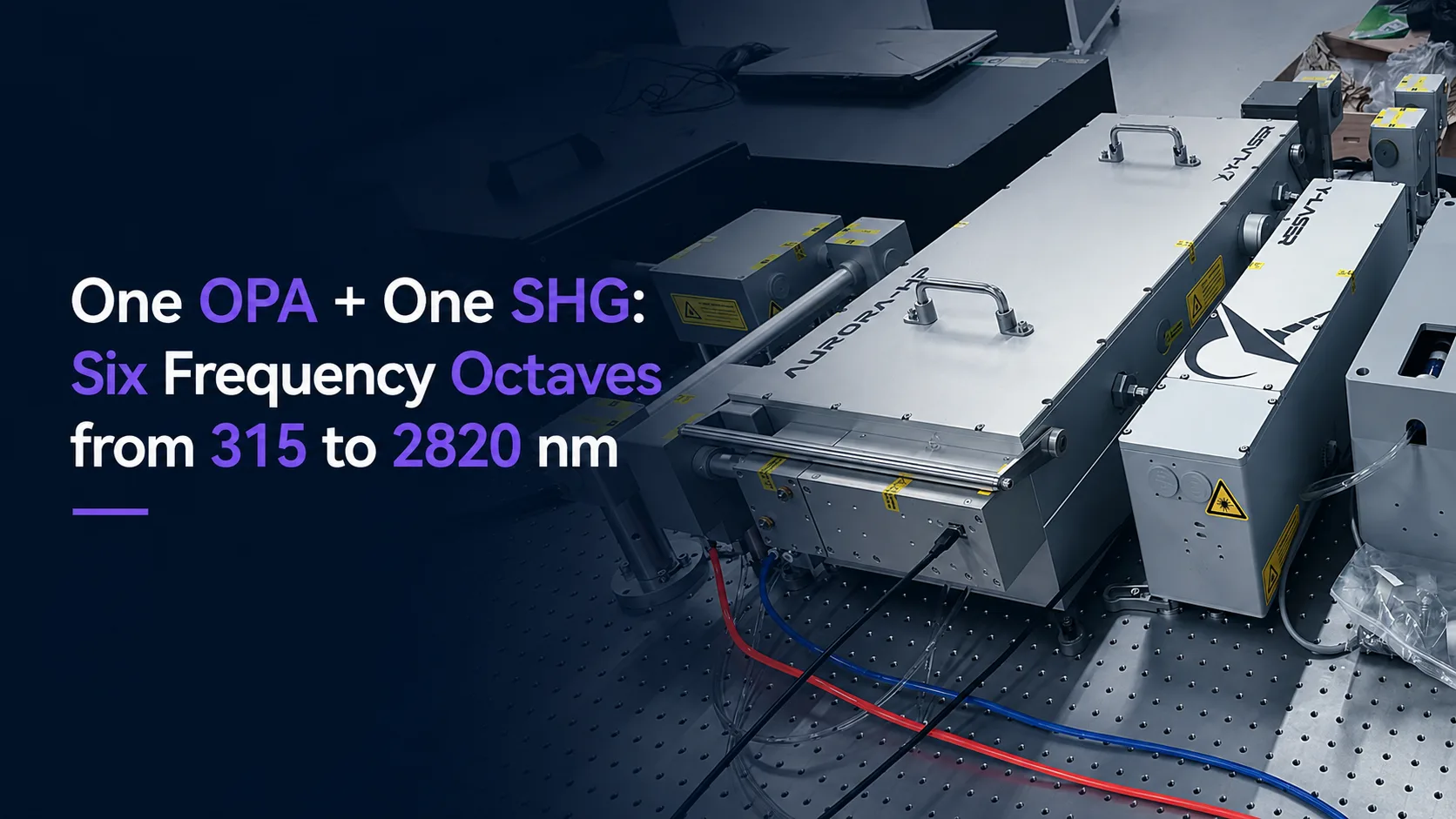
Over the last decade, 1030 nm Yb femtosecond lasers have become the de-facto standard for ultrafast platforms. But in real transient absorption (TA) pump-probe, photochemistry, materials photophysics and biological chromophore dynamics work, 1030 nm is only the starting point. What actually determines whether an experiment runs is whether the driver can change color on demand: perovskite band edges sit at 500 – 800 nm; TMD exciton peaks at 600 – 700 nm; quantum-dot interband absorption at 600 – 900 nm; organic CT states at 800 – 1500 nm; π–π* electronic transitions in the 315 – 450 nm deep-UV window. Every one of these targets asks the pump or probe arm to continuously cover a different band.
Y-LASER AURORA-HP + AU/SHG is engineered around exactly this cross-cutting requirement — one purchase, one instrument, and the ultrafast platform is opened up across the near-UV, visible, near-IR and short-wave IR at the same time.
1 · Highlights at a Glance

2 · OPA + SHG in 30 seconds
In plain terms:
▪ ▶ OPA (Optical Parametric Amplification) — inside a nonlinear crystal (BBO / LBO), one 1030 nm pump photon "splits" into a Signal photon and an Idler photon under energy conservation ω_p = ω_s + ω_i and momentum conservation k_p = k_s + k_i. Rotating the crystal angle moves the Signal continuously from 630 – 1030 nm; the Idler is locked by energy conservation and tracks continuously from 1030 – 2820 nm on the other side of the pump.
▪ ▶ SHG (Second-Harmonic Generation) — two fundamental photons at ω combine into one 2ω photon, halving the wavelength. Doubling the 630 – 1030 nm Signal into an SHG crystal extends the tuning further into the 315 – 515 nm deep-UV (SHS); doubling the 1060 – 1260 nm Idler covers 530 – 630 nm in the visible (SHI).
Combined, OPA + SHG lets one 1030 nm Yb driver hop across six full frequency octaves — from 315 nm deep-UV all the way out to 2820 nm SWIR, all continuously tunable.
3 · The AURORA-HP + AU/SHG Platform
Y-LASER AURORA-HP uses a "white-light seed + multi-stage BBO parametric amplification + AU/SHG doubling" architecture, and is compatible with any 1030 nm / 100 μJ / 100 kHz / <300 fs Yb main oscillator — including third-party pumps. Users can preserve their existing driver investment and simply add one AURORA-HP + AU/SHG unit to extend the platform’s spectral reach from 1030 nm to the full UV / VIS / NIR / SWIR range.
The platform is a three-module stack, engineered together rather than integrated after the fact:
▪ AURORA-HP OPA — high-energy optical parametric amplifier; Signal 630 – 1030 nm and Idler 1030 – 2820 nm continuous tuning; software-controlled wavelength switching; peak conversion 9.88 % @ 760 nm.
▪ AU/SHG doubling module — integrated with AURORA-HP; SHS extends into 315 – 515 nm deep-UV; SHI covers 530 – 630 nm in the visible; peak SHG conversion above 2.66 %.
▪ Compatible interface — supports third-party 100 μJ / 100 kHz Yb pumps. Polarization, dispersion and phase matching are calibrated together at the factory, removing the interface-efficiency losses typical of multi-vendor stacks.
4 · Why It Matters — the Data Speaks
■ Advantage 1 · OPA Signal Tuning Spectra (630 – 1030 nm)
Figure 1 shows AURORA-HP Signal spectra stepped across 630 – 1030 nm — more than 24 tuning wavelengths, each with a clean, complete peak, uniform amplitude, and no distortion at neighbouring wavelengths. This spectral consistency is exactly what lets every tuning point plug directly into the downstream TA experiment without re-alignment — the physical prerequisite for a production-grade OPA.
■ Advantage 2 · OPA Idler Tuning Spectra (1030 – 2820 nm)
Figure 2 shows the Idler spectra stepped from 1030 nm all the way to 2820 nm — extending beyond the 1030 – 2600 nm specification, and covering both the near-IR and SWIR bands relevant to organic vibrational modes (1200 – 1700 nm), semiconductor interband transitions (1500 – 2000 nm), quantum-dot SWIR features (1.2 – 2.5 μm) and biological transmission windows (1300 / 1700 nm).
 |  |
AURORA-HP OPA | Signal Tuning Spectra (stepped scan 630 – 1030 nm) | AURORA-HP OPA | Idler Tuning Spectra (stepped scan 1030 – 2820 nm) |
■ Advantage 3 · SHG Deep-UV Extension (SHS · 315 – 515 nm)
Figure 3 shows the AU/SHG output when doubling the Signal — extending the tuning range into 315 – 515 nm deep-UV / visible. This UV window (π–π* electronic transitions, MLCT bands in metal complexes, catalytic intermediate absorption) is precisely the band that traditionally required a separate dedicated UV source. With SHS integrated with the OPA, polarization and phase matching are calibrated in one shot at the factory — removing the conversion-efficiency losses that typically appear with third-party SHG add-ons.
■ Advantage 4 · SHG Visible Extension (SHI · 530 – 630 nm)
Figure 4 shows the AU/SHG output when doubling the Idler — covering 530 – 630 nm in the green-to-red visible band. This fills the visible-band gap between Signal 630 nm and SHS 515 nm, so the 315 – 2820 nm continuous tuning is truly continuous across all four spectral regions.
 |  |
AU/SHG | SHS Tuning Spectra (315 – 515 nm deep-UV / visible) | AU/SHG | SHI Tuning Spectra (530 – 630 nm visible extension) |
■ Advantage 5 · Full Tuning Curve — 315 – 2820 nm in One View
Figure 5 lays Signal + Idler + SHS + SHI on the same axis — the horizontal axis runs from 315 to 2820 nm across all four spectral regions, and the logarithmic vertical axis captures the full 40 mW – 1000 mW power envelope in a single view. The four arms stitch together seamlessly, giving a direct visual of what "one instrument, six frequency octaves" actually delivers.
■ Advantage 6 · 24 h Power Stability — 0.84 % RMS @ 750 nm
Figure 6 shows continuous 24-hour monitoring at the 750 nm working point with 919.9 mW average power — RMS stability 0.84 %, standard deviation 7.74 mW. This is comfortably inside the <1 % specification, and directly controls the baseline noise floor of downstream TA differential signals through the ΔA ∝ √(t/τ) statistical relation.
 |  |
AURORA-HP + AU/SHG | Full Spectral Tuning Curve · Signal 988 mW @ 760 nm (9.88 %) · Idler 485 mW @ 1445 nm (4.85 %) · SHS 266 mW @ 380 nm (2.66 %) · SHI 173 mW @ 630 nm (1.73 %) | AURORA-HP OPA | 24 h Power Stability @ 750 nm · 919.9 mW · 0.84 % RMS |
■ Advantage 7 · Application Engineering: compatibility with third-party Yb pumps
AURORA-HP is designed against a general 1030 nm / 100 μJ / 100 kHz Yb-CPA pump specification, so it can be added on top of an existing Yb driver as a single OPA + SHG upgrade — extending spectral reach without rebuilding the whole platform.
5 · Experiments Unlocked by One Platform
▪ UV-Vis TA pump-probe (315 – 630 nm) — SHS + SHI + Signal cover π–π* transitions, MLCT bands and biological chromophore absorption without a separate UV source.
▪ Vis-NIR TA pump-probe (630 – 1030 nm) — OPA Signal directly targets perovskite band edges, TMD excitons and quantum-dot interband absorption.
▪ SWIR ultrafast spectroscopy (1030 – 2820 nm) — OPA Idler directly covers organic vibrational bands, semiconductor interband transitions and biological transmission windows.
▪ Photochemistry intermediate dynamics — 315 – 450 nm deep-UV captures electronic transitions on the femtosecond time scale.
▪ Biological chromophore ultrafast dynamics — 530 – 600 nm (SHI) covers protein / pigment / fluorescent-probe absorption bands.
6 · Closing Notes
9.88 % Signal peak efficiency · 4.85 % Idler peak efficiency · 2.66 % SHS peak efficiency · 315 – 2820 nm continuous tuning · 0.84 % RMS @ 24 h — the core numbers delivered by Y-LASER AURORA-HP + AU/SHG map one-to-one onto the five physical requirements that any tunable ultrafast spectroscopy experiment actually depends on: Signal efficiency, Idler efficiency, UV extension, spectral coverage and long-term stability.
The engineering value of delivering OPA + SHG as one calibrated chain is more than convenience. Polarization, dispersion and phase-matching between OPA and SHG are locked in at the factory, so pump stability propagates cleanly to the OPA output and the four arms are spatially and polarization-aligned out of the box — physically lowering the baseline noise floor of every downstream TA signal, and letting users switch between four spectral regions without touching the optical path. This is what an integrated tunable ultrafast source looks like when it is engineered as one system.