Room-Temperature THz Source Breaks 0.4 % Conversion Efficiency in LiNbO₃--Y-LASER HELIOS-20W-HE Enables mJ-Class Short-Pulse Pumping at 10 kHz
HELIOS-20W-HE、AURORA-H-HP、HYPERION-G、Terahertz、Ultrafast Lasers、Strong Field Physics、Nonlinear Optics、Photonics、Laser Engineering、Yb Laser、THz Technology
July 17, 2026
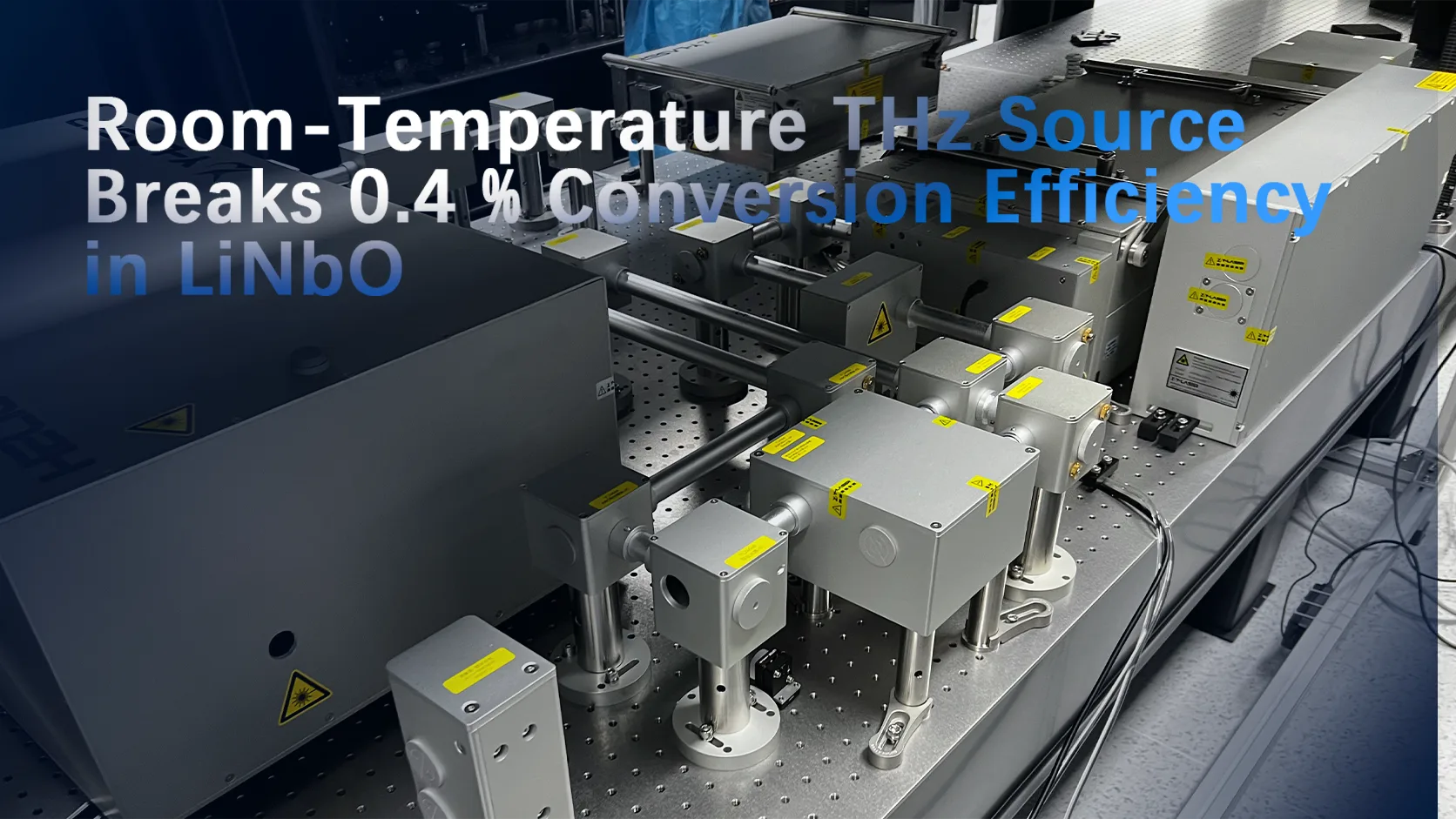
A research team led by Prof. Xiaojun Wu at Beihang University (BUAA) has just published a systematic study that moves room-temperature, high-average-power, strong-field terahertz generation from a long-standing experimental bottleneck toward engineering deployment. In a head-to-head comparison of two mainstream tilted-pulse-front pumping (TPFP) schemes — reflective grating vs. reflective echelon — under mJ-class, ~250 fs short-pulse conditions, the reflective echelon scheme delivered a record 0.4 % conversion efficiency, 4.66 μJ of single-pulse THz energy, and 51.7 mW of average THz power at room temperature in lithium niobate.
First author: Dr. Xieqiu Yu. Corresponding author: Prof. Xiaojun Wu. First affiliation: BUAA International Research Institute for Multidisciplinary Science. The work was published online in 2026 in High Power Laser Science and Engineering (Cambridge University Press, JCR Q1).
The pump laser used throughout this work is Y-LASER HELIOS-20W-HE — a high-energy Yb-doped CPA amplifier delivering 2 mJ single-pulse energy at 10 kHz, 226 fs pulse duration and 21 W average power at 1030 nm.

Paper: https://doi.org/10.1017/hpl.2026.10165
1 · Highlights at a Glance

2 · Why Strong-Field THz Is Hard: A Three-Way Constraint
Strong-field THz has remained scarce because it demands three things at once — phase matching inside the nonlinear crystal, sufficient pump peak power density, and a driver source that can hold thermal and pointing stability at high repetition rate. Any single weakness pulls the conversion efficiency back down to the sub-tenth-of-a-percent regime.
LiNbO₃ combined with TPFP is today the dominant route to high-intensity THz. Two engineering approaches are commonly used to create the required pulse-front tilt: diffraction gratings, which deliver high diffraction efficiency but introduce angular dispersion that stretches the pulse; and reflective echelon mirrors, which are dispersion-free but have historically shown lower efficiency. Which one wins under a given pump regime — and in particular under short-pulse, mJ-class conditions — had not been answered systematically until now.
Over the last few years, most commercial Yb femtosecond sources on the market were either stuck at >500 fs pulse duration or unable to reach mJ-class energy at high repetition rate. Peak power density was capped, and non-linear conversion efficiency along with it. In effect, the availability of a stable, mJ-class, <300 fs, high-rep-rate driver is itself the gating precondition to pushing THz conversion efficiency toward 0.4 %.
3 · Experiment: One Pump Source, Two TPFP Routes

Fig. 1 Experimental setup and laser parameters. (a) TPFP schemes with grating vs. echelon; (b) Laser spot ~5.3 mm (1/e²); (c) Pump and signal pulse widths; (d) OPA signal spectrum.
The whole platform is driven by the HELIOS-20W-HE main oscillator at 1030 nm / 2 mJ / 10 kHz / ~250 fs for the THz generation arm; the same laser is beam-split into an AURORA-H-HP OPA whose 800–900 nm, <55 fs output serves as the EOS (electro-optic sampling) probe. Scans were acquired under temperature- and humidity-controlled laboratory conditions.
■ Route A — Reflective Grating Scheme

Fig. 2 Grating scheme. (a) Principle; (b) THz energy & efficiency vs. pump; (c) time-domain waveform; (d) THz spectrum.
At 226 fs pulse duration and 1.44 mJ pump energy, the grating route achieved 0.26 % conversion efficiency, 3.79 μJ single-pulse THz energy, 41.8 mW average power, a spectrum spanning 0.1 – 3 THz centered at 0.54 THz, and a peak field of ~680 kV/cm.
■ Route B — Reflective Echelon Scheme (Best)

Fig. 3 Echelon scheme. (a) Principle; (b) THz energy & efficiency vs. pump; (c) time-domain waveform; (d) THz spectrum.
The echelon is composed of 75 steps (187 μm wide × 85 μm high) at normal incidence, discretizing the pump into 75 delayed sub-pulses that build an effective 42.3° tilt; a 100 mm focal-length lens (4.85× demagnification) images the tilt onto the crystal, matching the 63° apex angle. Adjacent sub-pulses are separated by 567 fs — far shorter than a THz oscillation period — so they add coherently. At 250 fs pulse duration and 1.15 mJ pump energy, the echelon route delivered 0.4 % conversion efficiency, 4.66 μJ single-pulse THz energy, 51.7 mW average power, a 0.1 – 2.3 THz spectrum centered at 0.44 THz, and a 50 dB dynamic range.
Take-away — At the same pump fluence (~46 mJ/cm²), the echelon scheme reaches 0.39 % while the grating scheme reaches 0.26 %. The dispersion-free nature of the echelon becomes decisive under short-pulse, high-energy conditions.
■ Pulse-Duration and Pump-Power Scans

Fig. 4 (a) THz energy vs. pump pulse duration; (b) THz energy vs. pump power and spot size.
Shortening the pump pulse from >500 fs down to ~250 fs alone more than doubles the optical-rectification efficiency; the large-spot + echelon combination tops out at 51.7 mW, the highest average THz power reported in this study.
4 · Behind the Numbers: the Y-LASER Pump Platform
Pushing THz efficiency from the second decimal place up toward half a percent begins with a driver source that simultaneously delivers high single-pulse energy, short pulse duration, high repetition rate, and long-term stability. Y-LASER HELIOS-20W-HE is a high-energy Yb-doped CPA amplifier built precisely around that specification.
■ HELIOS-20W-HE · 24 h Power Stability
A 24 h continuous acquisition at 10 kHz delivers 22.4 W average power at 0.12 % RMS — the trace is flat to the eye, with no discernible drift. This is precisely what enabled the team to sweep TPFP energy–efficiency curves back-to-back over multiple nights.
■ HELIOS-20W-HE · 24 h Pointing Stability
Recorded through a 500 mm focusing lens onto a beam-profiling camera, both X and Y traces stay drift-free across 24 h. Position RMS is 1.93 μm, corresponding to 3.86 μrad angular pointing stability — well within the tolerance of long-baseline 4-f imaging and precision crystal alignment.
 |  |
HELIOS-20W-HE | 24 h Power Stability @ 10 kHz · 22.4 W · 0.12 % RMS | HELIOS-20W-HE | 24 h Pointing Stability @ 10 kHz · RMS 1.93 μm → 3.86 μrad |
■ HELIOS-20W-HE · Spectrum and Pulse Duration
 |  |
HELIOS-20W-HE | Output Spectrum @ 10 kHz · λc = 1034.7 nm · FWHM ≈ 7.7 nm | HELIOS-20W-HE | Autocorrelation @ 10 kHz · Pulse Duration = 226.3 fs (Gauss, R² = 1.000) |
A stable centre wavelength and near-Fourier-limited pulse duration are the enabling foundation for any downstream OPA conversion or MPC compression stage.
5 · Same-Source Extensions: AURORA-H-HP OPA + HYPERION-G MPC
The EOS probe in this paper needs 800–900 nm, <55 fs pulses — a requirement that is precisely covered by the other two products on the same HELIOS-20W-HE platform: AURORA-H-HP OPA for wavelength tuning, and HYPERION-G MPC for pulse compression. A single main oscillator, beam-split, delivers both pump and probe arms in one integrated layout.
■ AURORA-H-HP OPA · 650 – 2600 nm Broadband Tuning
 | |
AURORA-H-HP OPA | Signal + Idler Tuning Curve · Peak 172 mW @ 820 nm | 88 mW @ 1463 nm |
Signal spans 650–900 nm and Idler spans 1200–2600 nm; the 780–840 nm plateau region reaches 160–172 mW — the exact window used for EOS probing in this paper.
 |  |
AURORA-H-HP OPA | Signal Tuning Spectra (15 wavelengths from 650 to 950 nm) | AURORA-H-HP OPA | Idler Tuning Spectra (15 wavelengths from 1200 to 2600 nm) |
The spectral consistency across the entire Signal / Idler tuning range — clean peak shape at every centre wavelength, no intensity dropouts, no anomalous features — is precisely what preserves short, clean EOS probe pulses and keeps downstream coherent spectroscopy / up-conversion imaging predictable.
■ AURORA-H-HP OPA + SCMP · 24 h Power Stability
 | |
AURORA-H-HP OPA + SCMP | 24 h Power Stability @ 750 nm · 135 mW · 0.3031 % RMS |
A 24 h acquisition at 750 nm yields 135 mW mean, 0.3031 % RMS, and <3 mW peak-to-peak drift — enough headroom to run overnight THz-TDS with high SNR.
■ HYPERION-G MPC · From 249 fs to 33.4 fs in One Stage
The multi-pass cell (MPC) uses the industry-standard SPM broadening + chirped-mirror dispersion compensation architecture, compressing HELIOS-class ~250 fs output down to 33.4 fs — a 7.5× compression ratio at 93.07 % throughput.
 |  |
HYPERION-G MPC | Input vs Output Spectrum (SPM broadening) · Pre-compression 13 nm → Post-compression 75 nm | HYPERION-G MPC | Autocorrelation Pre- vs Post-Compression · Post-Compression FWHM = 33.4 fs |
The autocorrelation trace above directly compares Pre- and Post-Compression pulses: the same laser output collapses from ~249 fs down to 33.4 fs after the MPC, with a sharp Post trace and no shoulder residues — indicating a very clean compression.
 |  |
HYPERION-G MPC | 24 h Power Stability @ 100 kHz · 19.08 W · 0.089 % RMS | HYPERION-G MPC | 24 h Pointing Stability @ 100 kHz · RMS 4.86 μm → 10.8 μrad |
Running at 100 kHz and 19.08 W over 24 h, the MPC output holds 0.089 % RMS in power and 10.8 μrad in pointing — a stability envelope that comfortably supports overnight attosecond, HHG and THz-TDS acquisitions.
6 · Closing Notes
This work by the BUAA / Wu Xiaojun team is the first systematic quantitative comparison of two mainstream TPFP schemes inside the real engineering window of mJ-class, short-pulse, room-temperature pumping — and it decisively picks short-pulse-plus-echelon as the preferred route. The conclusion is directly transferable to strong-field THz platforms designed for THz imaging, ultrafast electron acceleration, non-linear THz spectroscopy and beyond.
For Y-LASER, it also validates HELIOS-20W-HE as a "high-energy + short-pulse + high-rep-rate + long-term-stable" driver platform — delivering 2 mJ / ~226 fs / 10 kHz directly, with 0.12 % RMS drift over 24 h, without any external post-compression. The platform is being deployed today as the driver of choice for TPFP THz sources, HHG, attosecond, and precision accelerator physics.
■ Product Family
▪ HELIOS-20W-HE — Yb-doped CPA femtosecond amplifier; 2 mJ @ 10 kHz / 226 fs / 21 W; 10 / 50 / 100 kHz rep-rate options in one unit.
▪ AURORA-H-HP OPA — continuous tuning 650 – 2600 nm; peak Signal 172 mW @ 820 nm; peak Idler 88 mW @ 1463 nm.
▪ HYPERION-G MPC — one-stage compression 249 fs → 33.4 fs; 7.5× ratio; 93 % throughput; 0.089 % RMS @ 24 h.
▪ Extensions — HHG, THz-TDS, pump-probe and SCMP front-ends configurable on the same HELIOS platform.
If you are building a TPFP THz source, ultrafast electron acceleration, attosecond or non-linear spectroscopy platform, get in touch with the Y-LASER team for full technical specifications and up-front optical-path simulation.