Sub-Kilowatt-Class Yb Femtosecond + Multi-Pass Cell Post-Compression
HYPERION-G-HE、Femtosecond Laser、Yb Laser、MPC、Pulse Compression、HHG、XUV、EUV
June 4, 2026
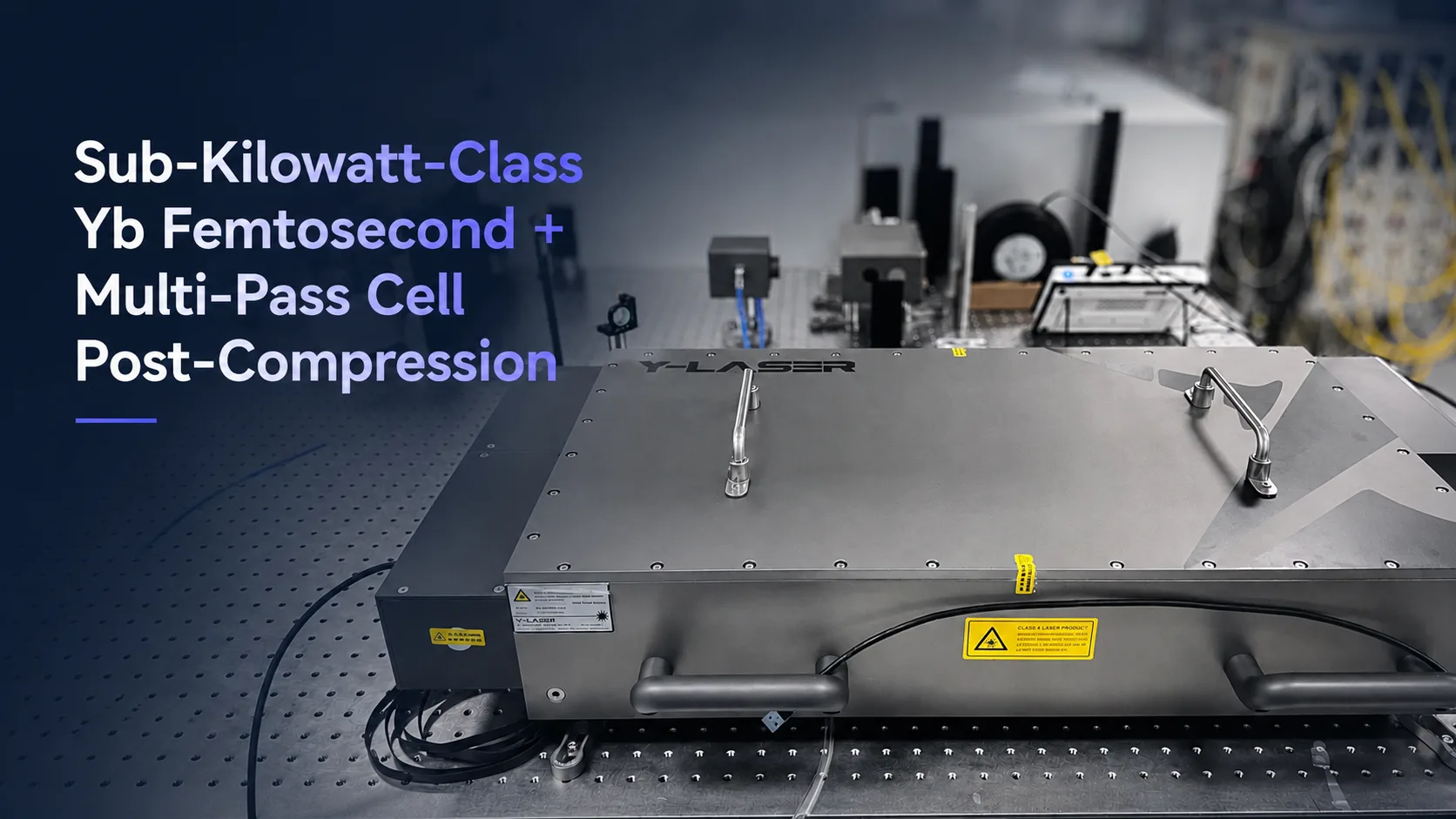
On the same HYPERION-G-HE multi-pass cell (MPC) compressor — previously validated at 50 kHz / 20 W in factory testing — we recently completed on-site acceptance at 1 MHz / 512 W injection. Output: 497.7 W average power, 46.4 fs FWHM (Sech² fit, R² = 0.988), 97.2 % overall transmission, and 0.33 % RMS power stability over 16 hours of continuous burn-in. A 25× scaling of injection power, on the same hardware — and the transmission efficiency actually improved.
1. Why HHG / XUV / EUV is bottlenecked on average power
High-harmonic generation (HHG) is the physics that lifts visible-to-near-IR femtosecond light into coherent EUV (10–124 nm) and soft X-ray photons. When the driver intensity at the gas target reaches 10¹³–10¹⁴ W/cm², an outer-shell electron is field-ionized, accelerated across a half-cycle, and recombines with the parent ion — emitting coherent harmonics at every odd multiple of the fundamental, up to the cut-off energy E_cutoff ≈ I_p + 3.17 × U_p. HHG underwrites all of attosecond science and a growing list of EUV applications: lithography metrology, time-resolved ARPES (TR-ARPES), coherent diffractive imaging (CDI), EUV holography.
What's quietly capping these applications is the average power of the driver. HHG conversion efficiency is intrinsically 10⁻⁶ to 10⁻⁸ per pulse. To reach 10¹²–10¹³ photons/s of XUV flux — the threshold that makes TR-ARPES, EUV CDI, and attosecond streaking practical at hour-scale acquisition times — the driver has to scale toward the kilowatt regime.
Ti:Sapphire couldn't get there. The single-pulse-energy × repetition-rate product has been pinned at 1–10 W for two decades, bounded by thermal lensing and crystal damage. When next-generation EUV / attosecond science demands 10² W to start and the kilowatt class as a target, Ti:Sapphire is physically out. The job falls to industrial 1030 nm Yb femtosecond lasers — except Yb gain bandwidth is only 5–10 THz, and direct Yb output sits at 200–300 fs FWHM, far longer than the < 50 fs HHG needs. This is precisely the gap MPC post-compression fills.
2. Sub-kilowatt + MPC: why the physics and the engineering align
The gas-filled multi-pass cell (MPC) can be summarized in three sentences:
■ (1) The femtosecond pulse enters a Herriott-type reflective cavity filled with a few bar of noble gas (typically Ar / Kr / He).
■ (2) The pulse makes 30–60 passes; each pass accumulates self-phase modulation (SPM, n₂I), symmetrically broadening the spectrum and adding a frequency chirp in time.
■ (3) Outside the cavity, chirped mirrors apply the opposite group-delay dispersion (GDD), recompressing the broadened pulse back toward the transform limit.
Three physical reasons make MPC the standard answer for sub-kilowatt femtosecond post-compression:
■ Power ceiling. A reflective cavity with a large mode area sidesteps the surface and bulk damage thresholds that cap fiber-based broadening at the 100 W class. MPCs comfortably handle 500 W to 1+ kW.
■ Frequency-agnostic nonlinearity. Gas Kerr nonlinearity is essentially flat across the wavelengths a Yb / Ho / Tm system can generate, so the same MPC platform extends from 1030 nm to 2000 nm sources.
■ Mode-quality preservation. Herriott-type multi-pass designs preserve a Gaussian transverse mode — output M² stays close to input M², avoiding the spatial-mode distortions typical of fiber-based broadening.
The most important property for high-power deployment is platform scalability: the same MPC hardware can be re-tuned for injection powers spanning two orders of magnitude — by re-calibrating gas pressure, dispersion compensation, and output attenuation alone. This is exactly what the on-site acceptance test demonstrates.
For sub-kilowatt-class femtosecond post-compression, MPC is not "one option" — it is the only architecture that simultaneously delivers a high power ceiling, preserved mode quality, low noise transparency, and platform scalability across two orders of magnitude of injection power.
3. On-site validation: HYPERION-G-HE @ 1 MHz / 512 W
In 2026, Y-LASER completed on-site acceptance testing of a customized HYPERION-G-HE MPC compressor (serial YLM250801-001) at a leading Chinese research institute. The same MPC had previously passed factory testing at 50 kHz / 20 W injection (19.598 W / 34.3 fs out, 95 % transmission). On site, the identical hardware was driven by a 1 MHz / 512 W Yb master — a 25× scaling of injection power.
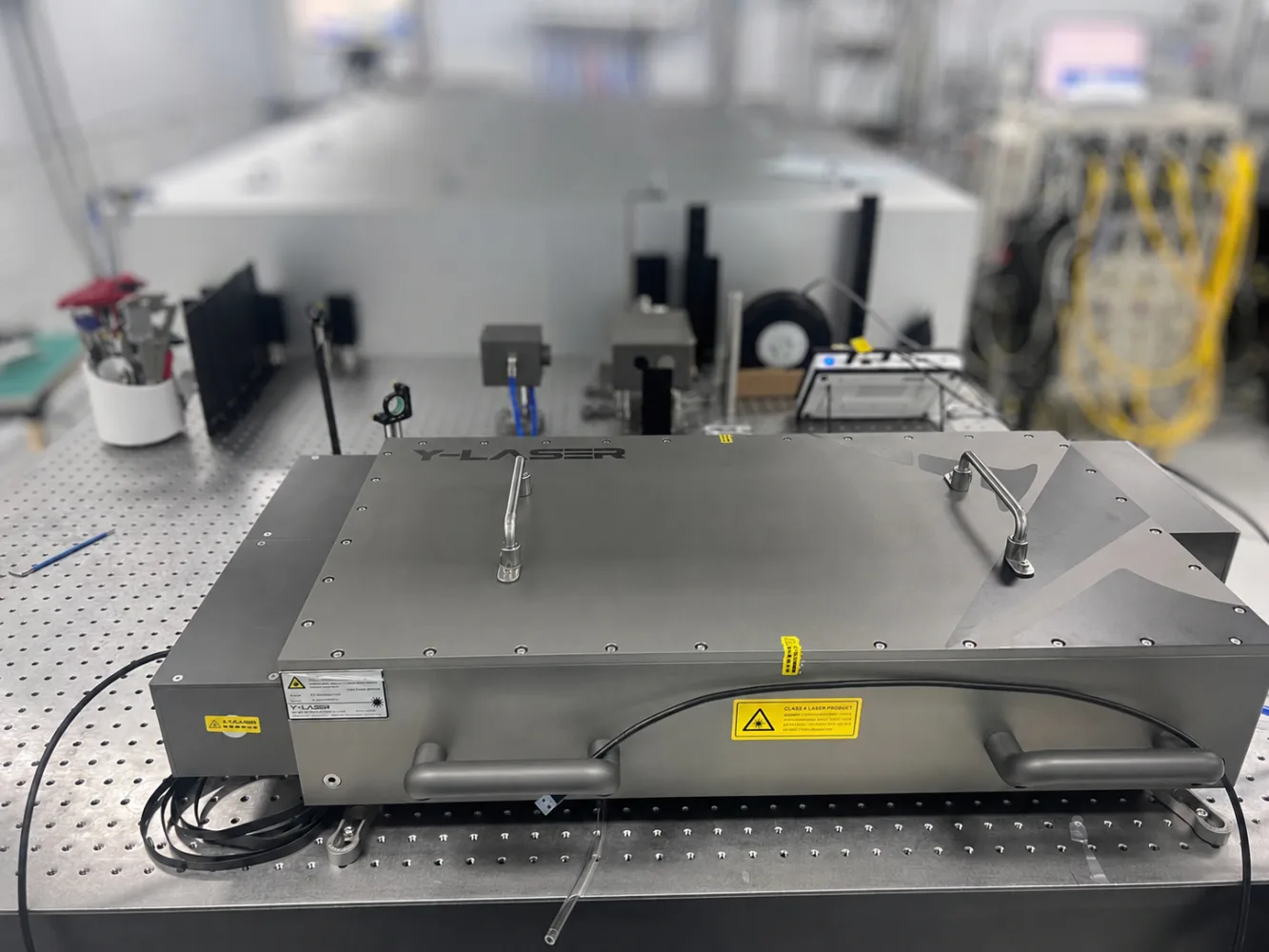 | 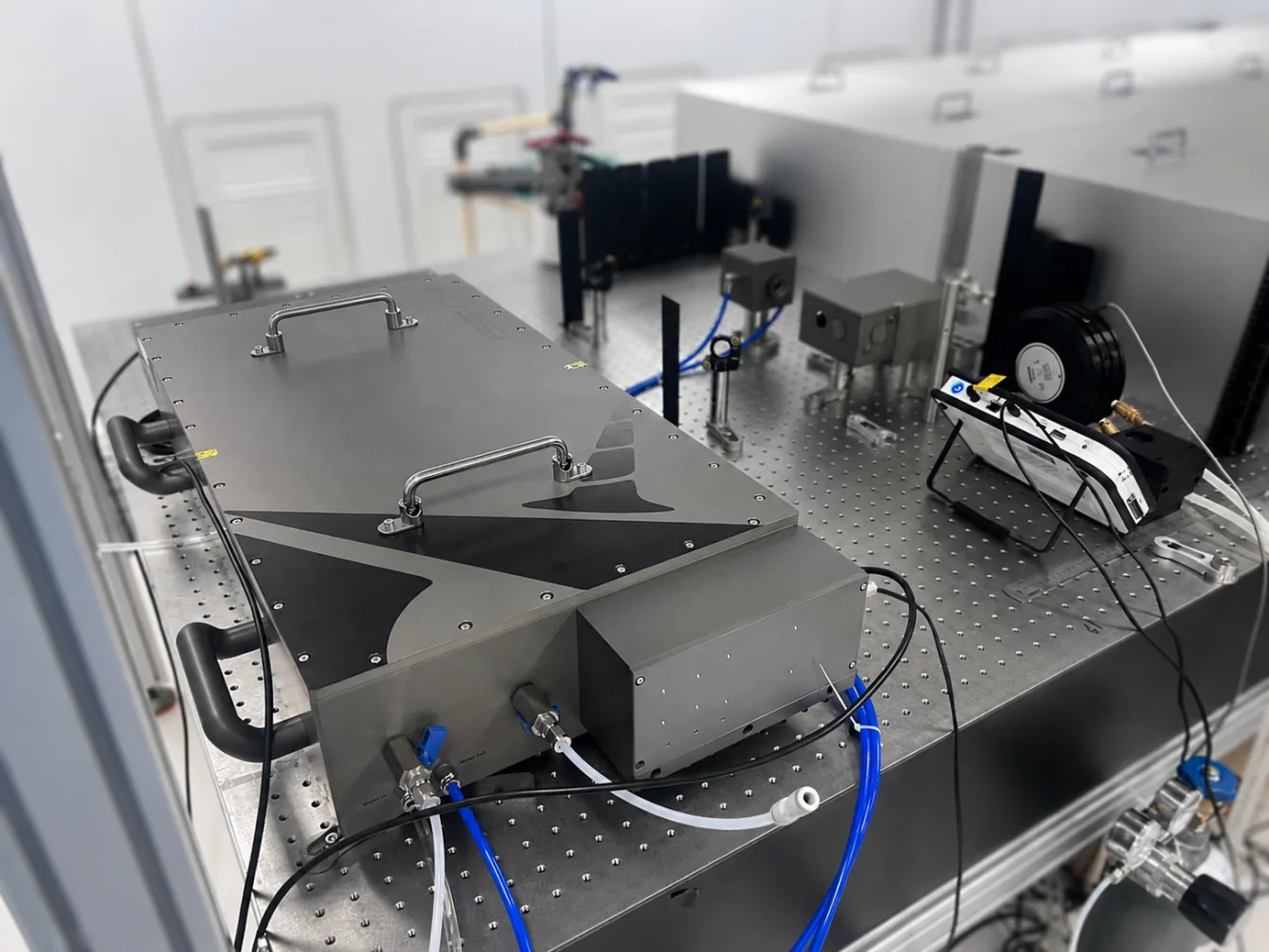 |
Fig. 1&2 HYPERION-G-HE MPC compressor in the customer's lab — the same hardware that previously cleared 50 kHz / 20 W factory acceptance, now operating at 1 MHz / 512 W. | |
3.1 System configuration
■ Pump: 1030 nm Yb femtosecond master · 512 W / 512 µJ @ 1 MHz / 264 fs FWHM
■ MPC body: HYPERION-G-HE Herriott-type cell · 1.8 bar Argon · 21.94 °C / 31.93 % RH
■ Auxiliaries: chirped-mirror GDD compensation, output attenuator, near-field + far-field beam monitors, full Class-IV interlock package
■ Instruments: Chuangshi L/300-1100 spectrometer, PulseCheck-150 autocorrelator, Coherent 3000W thermal head, Dataray WinCamD-LCM beam profiler
3.2 Pulse duration: 264 fs → 46.4 fs (5.7× compression)
Measured output pulse FWHM was 46.4 fs from the Sech² fit of the autocorrelation (ACF FWHM 69.2 fs, Pulse Duration 46.4 fs, R² = 0.988, PulseCheck-150). 5.7× compression — meeting the < 50 fs design target with margin.
Worth noting: at sub-kilowatt injection the compressed pulse is slightly broader than at the 50 kHz / 20 W factory configuration (231 → 34.3 fs, 6.7×). This is the expected energy-vs-phase-cleanliness trade-off: at higher power, stronger gas nonlinearity tends to over-broaden the spectrum and disturb chirp linearity, so the engineering choice is to keep dispersion compensation deliberately conservative — trading a few femtoseconds for power stability and beam quality.
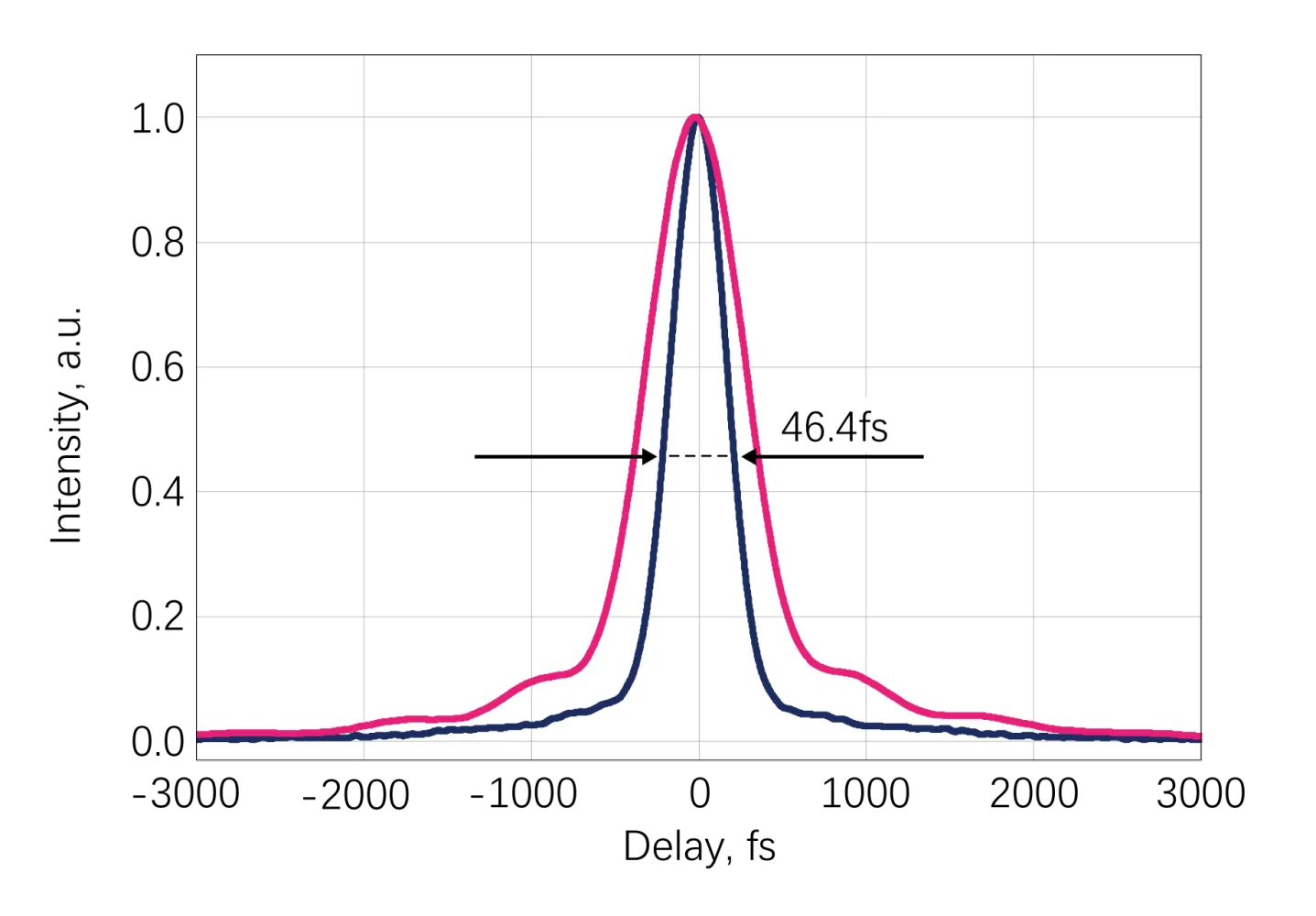 | |
Fig. 3 MPC Input / Output Pulse Width· Sech² fit · Pulse Duration = 46.4 fs · R² = 0.988 (PulseCheck-150) |
3.3 Spectrum: 16.3 nm → 73 nm (4.5× broadening at −10 dB)
The 1030 nm pump entered with 16.3 nm −10 dB bandwidth. After SPM broadening through 1.8 bar Argon, the output −10 dB bandwidth reached 73 nm — comfortably supporting the transform-limit equivalent of a 46.4 fs pulse. Spectral center remained at 1030 nm, locked to the chirped-mirror GDD compensation curve.
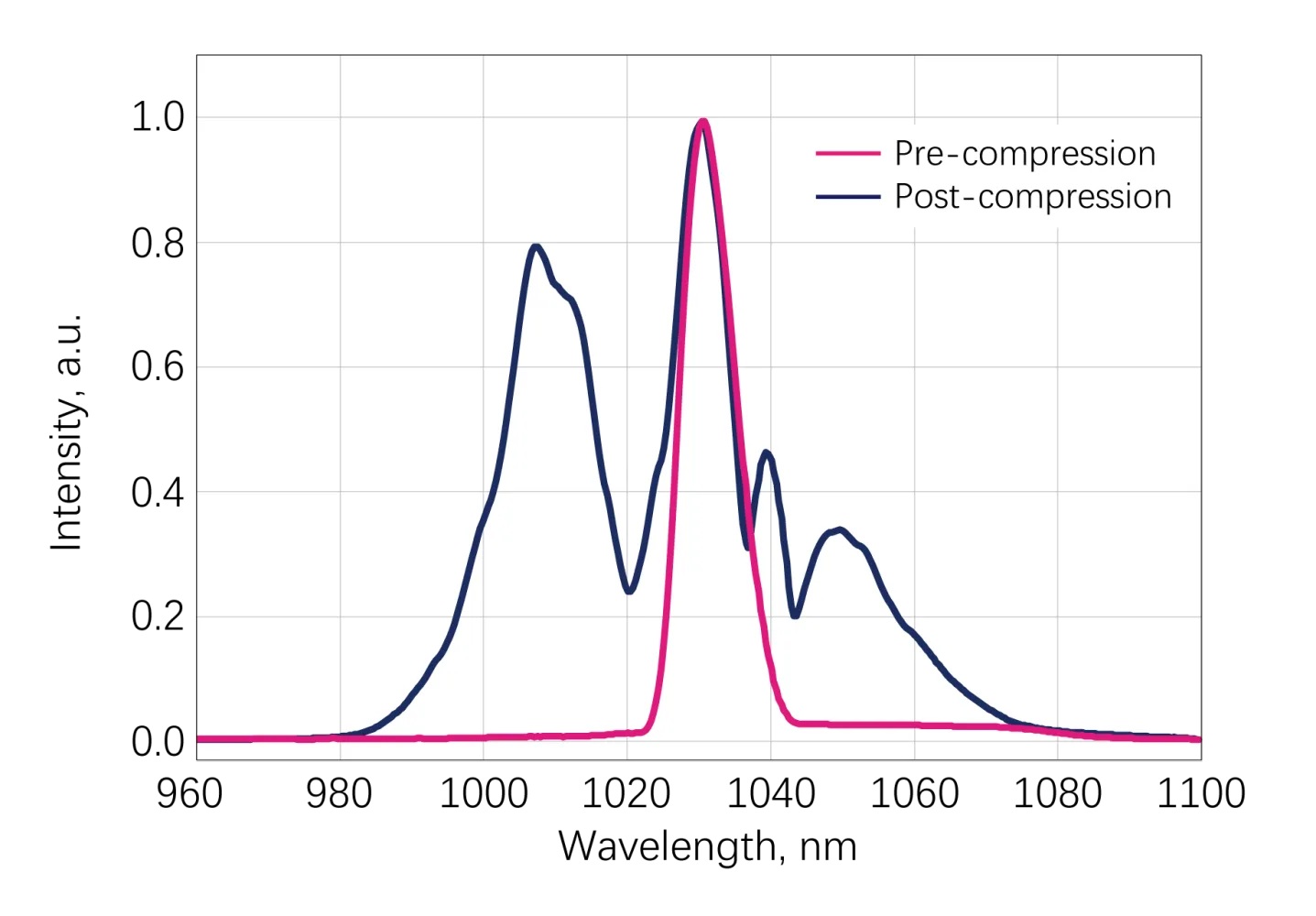 | |
Fig. 4 Input vs. output spectra (on-site acceptance report) · Input −10 dB BW = 16.3 nm, output −10 dB BW = 73 nm (Chuangshi L/300-1100) |
3.4 Long-term power stability: 497.7 W · 0.33 % RMS over 16 hours
Continuous 16-hour burn-in at 497.7 W average power gave 0.33 % RMS stability (Coherent 3000W thermal head). 16 hours is the duration that actually matters: it covers a complete HHG scan, a TR-ARPES multi-dataset acquisition, or an EUV CDI long exposure — meaning the system can be left unattended overnight and deliver publication-quality data the next morning, with no re-alignment, no re-warming.
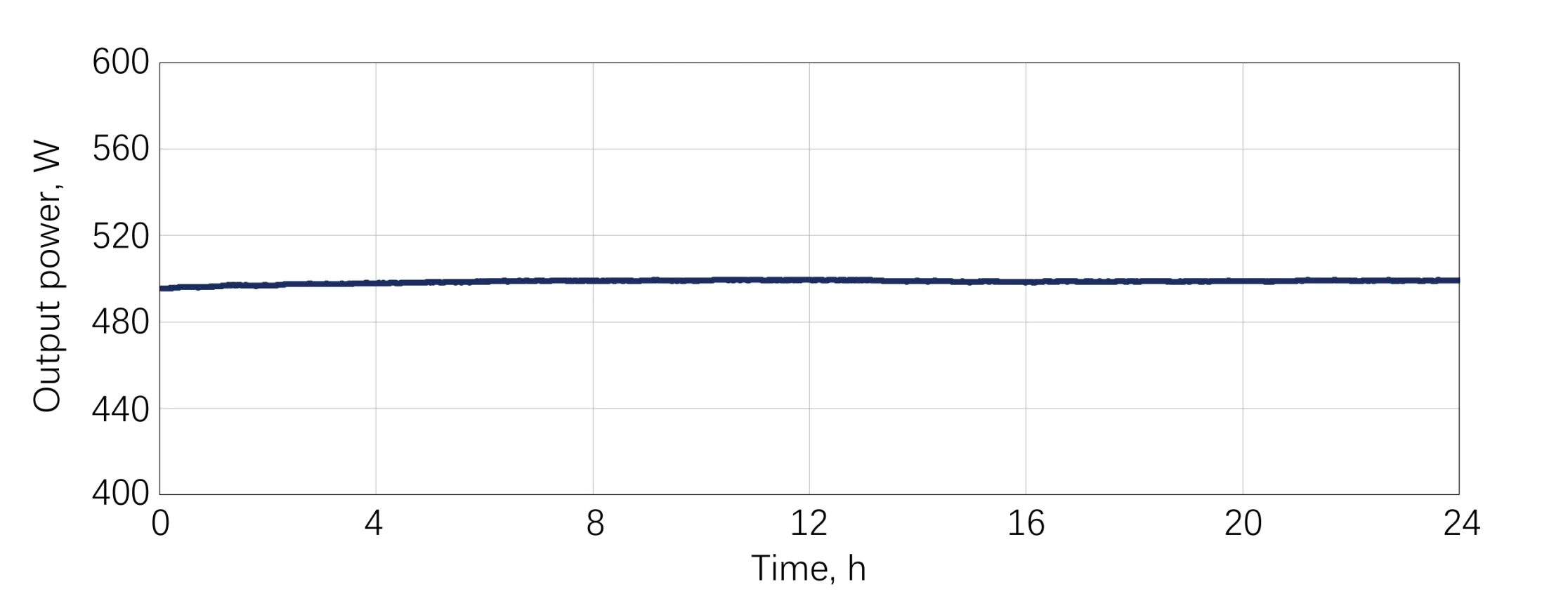 | |
Fig. 5 MPC 16-hour long-term power stability · Mean = 497.7 W · RMS = 0.33 % (Coherent 3000W thermal head · reconstructed from acceptance-report RMS = 0.33 %) |
3.6 Full acceptance summary
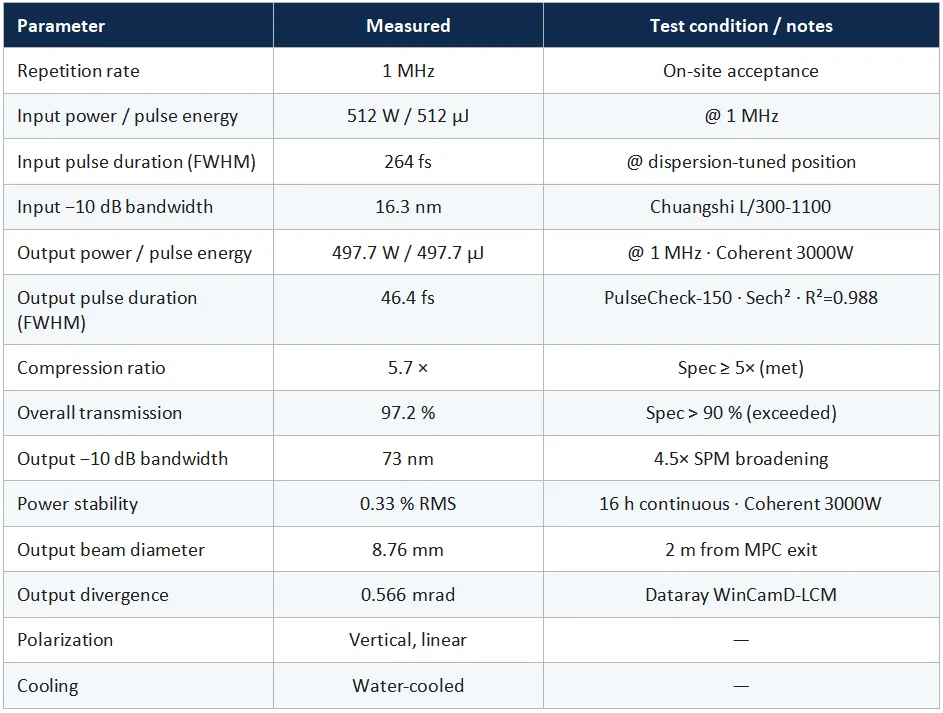
The most important comparison is not within this table — it's across the two test campaigns. Same MPC hardware: factory 50 kHz / 20 W → on-site 1 MHz / 512 W, with transmission efficiency improving from 95 % to 97.2 %. This is what platform scalability looks like.
4. What sub-kilowatt femtosecond unlocks
When 1030 nm, 1 MHz, ~500 W average power, sub-50 fs land in the same beam, a class of previously gated experiments becomes practical:
■ High-flux HHG XUV sources. XUV photon flux scales linearly with driver average power; jumping from 10⁹–10¹⁰ photons/s to 10¹²–10¹³ photons/s turns EUV CDI, TR-ARPES, and EUV holography from demonstration experiments into routine experiments.
■ EUV and soft X-ray coherent sources. Coherent harmonics across 6.7–124 nm support EUV lithography metrology (replacing some synchrotron use cases), nanoscale element-specific imaging, and in vivo soft X-ray microscopy.
■ Attoscience. Sub-50 fs IR drive at MHz repetition rate finally provides the statistics and the temporal resolution that attosecond streaking and attosecond TA have always needed.
■ Time-resolved ARPES (TR-ARPES). High-repetition XUV compresses data acquisition from days to hours; high average power enables photoemission electron microscopy (PEEM) at meaningful flux.
■ Seed upgrades for nonlinear frequency conversion. A sub-50 fs / sub-kilowatt seed raises the instantaneous peak power and the available bandwidth of every downstream OPCPA, parametric amplifier, and high-field THz source.
5. Closing thought
Sub-kilowatt-class femtosecond post-compression is not just "higher power." It is the infrastructure upgrade that takes HHG, attoscience, and EUV coherent sources from the boutique-physics phase into the engineered-application phase. These three lines have spent the past decade in "physics works, flux insufficient." Pushing the driver from 10 W to the kilowatt class is the move that finally lets them leave a handful of top-tier labs and enter industrial metrology and broader academic adoption.
This on-site acceptance demonstrates that a Chinese-built Yb high-power laser paired with a Chinese-built gas MPC post-compressor can now deliver 497.7 W / 46.4 fs / 97.2 % transmission / 0.33 % RMS — a hardware baseline credibly good enough to drive next-generation HHG / XUV / EUV chains.
As Yb platforms continue scaling toward 1+ kW and 2+ kW average power, "sub-kilowatt sub-50 fs Yb femtosecond drive" will move from being a custom solution for a handful of top-tier labs into a standard tool for many — a tangible step from the Chinese ultrafast industry into high-flux XUV / EUV applications.