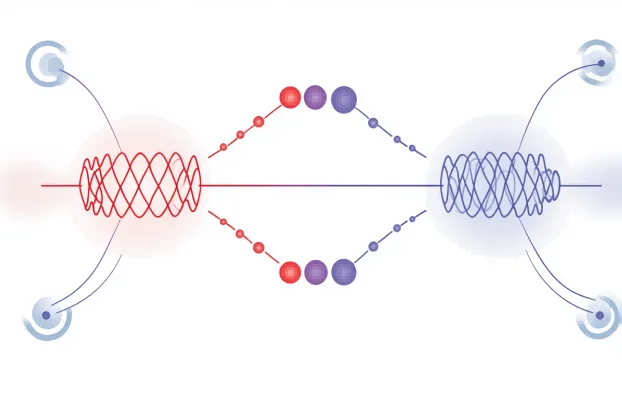
Nonlinear optics is a science that studies the nonlinear effects produced when light interacts with matter, involving a series of complex and delicate physical processes. These nonlinear effects include Second Harmonic Generation (SHG), Third Harmonic Generation (THG), Self-Phase Modulation (SPM), Cross-Phase Modulation (XPM), and Four-Wave Mixing (FWM). Nonlinear effects usually occur in specific nonlinear media, which exhibit optical properties nonlinearly related to light intensity under strong illumination.
The subjects of nonlinear optics research include not only traditional effects such as SHG and THG, but also phenomena such as the Kerr effect, two-photon absorption, and photorefraction. These effects are especially significant in specific nonlinear media such as crystals, polymers, liquid crystals, and optical fibers. Under strong illumination, these media exhibit a nonlinear response that varies with light intensity, giving them broad applications in optical communication, optical information processing, and laser technology.
In optical communication, nonlinear optical technology is used to develop advanced optical devices such as fiber amplifiers, all-optical logic gates, and supercontinuum generators. These technologies not only improve the data transmission rate and bandwidth of optical fiber communication but also help meet the ever-growing demand for data processing.
Multiphoton microscopy and nonlinear spectroscopy techniques (such as Coherent Anti-Stokes Raman Scattering (CARS) and Sum-Frequency Generation (SFG)) provide deep molecular-level information in biological imaging and materials science. These advanced techniques enable scientists to observe living cells and complex material structures at high resolution, gaining deep understanding of their internal workings.
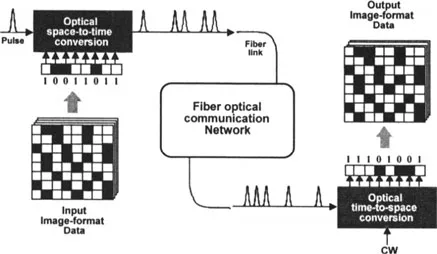
Figure: Ultrafast spatio-temporal processing achieving multiplexers and demultiplexers when transmitting images or image-format data through optical fibers.
The high peak power and extremely short pulse width of femtosecond lasers make them an ideal light source for studying and applying nonlinear optical effects. Femtosecond lasers can be used not only for high-efficiency frequency-conversion processes, but also play a key role in the study of ultrafast phenomena, such as studying molecular vibrational dynamics, electron transfer processes, and chemical reaction pathways. In ultrafast spectroscopy, femtosecond laser technology is used to excite and probe the ultrafast dynamic processes of materials, thereby providing a unique perspective on events occurring at the molecular and atomic scale.
In optical communication, nonlinear optics is used to make various optical devices such as optical switches, optical amplifiers, and wavelength converters. The high peak power of femtosecond lasers makes them an ideal light source for achieving high-efficiency nonlinear processes. For example, femtosecond lasers can effectively produce second and third harmonics for optical frequency conversion.