Femtosecond lasers play a vital role in generating high-intensity X-rays, which is crucial for fast, high-resolution imaging and analysis. For example, they play an important role in medical imaging, materials analysis, and scientific research. X-rays produced by femtosecond lasers can be used to study ultrafast phenomena in matter, such as chemical reactions, phase transitions, and electron dynamics. This is because femtosecond lasers, through nonlinear optical processes such as high-harmonic generation (HHG) and laser–plasma interaction, can produce X-rays. These processes involve converting the energy of the femtosecond laser into higher-energy X-rays, providing a new way to study matter in depth.
In medical imaging, X-rays produced by femtosecond lasers are used to provide high-resolution images, which is crucial for diagnosing complex diseases, monitoring treatment, and performing precise surgery. For example, they can be used for cancer detection, bone imaging, and soft-tissue analysis, providing clearer and more detailed images than traditional X-ray imaging.
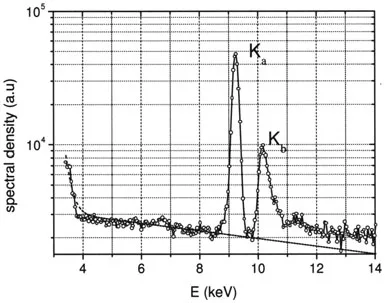
Figure: X-ray spectrum.
In materials science, X-rays produced by femtosecond lasers can be used to analyze the internal structure of materials, including crystal structure, defects, and stress distribution. This is of great value for developing new materials and improving the performance of existing materials. In physics, chemistry, and biology research, X-rays produced by femtosecond lasers are used to observe and analyze ultrafast phenomena such as chemical reactions, phase transitions, and electron dynamics.
Femtosecond lasers produce X-rays through nonlinear optical processes such as HHG, allowing finer structural and dynamic studies of target matter. In addition, femtosecond lasers are used to produce high-temperature plasma, which then emits high-energy X-rays. This method is especially effective for deep-penetration imaging and material characterization.
Another important application of the femtosecond laser is improving the time resolution of X-ray sources, which is crucial for capturing and studying rapidly changing physical, chemical, and biological processes. In addition, the application of the femtosecond laser also improves control over X-ray characteristics, including the adjustment of energy, intensity, and pulse duration.
In summary, the application of femtosecond lasers in generating high-intensity X-rays not only plays a vital role in medical imaging, materials science, physics, chemistry, and biology research, but also provides new possibilities and tools for scientific research and technological development in these fields.