Conical Drilling
Conical or tapered drilling with ultrafast lasers refers to the precise fabrication of holes with controlled taper angles and smooth inner walls in hard and brittle materials, typically achieved by adjusting the laser incidence angle, beam focus, or using spiral scanning techniques. It is critical for injection nozzles, optical fiber alignment, and aerospace cooling holes.

Conical drilling is an advanced material-processing method specifically used to create conical holes with specific angles and dimensions in various materials. This drilling technique relies on specially made conical drill bits designed to gradually widen the hole as they enter the material. The notable feature of conical drilling is its ability to create precise conical holes on the material surface, thereby meeting strict requirements for hole diameter and shape in specific industrial applications. This technique surpasses traditional straight-diameter drilling methods in both precision and efficiency.
Conical drilling is widely used in aerospace, precision machinery manufacturing, and medical devices. In aerospace, conical drilling is often used to make precise connection points in engine parts and structural components. These conical holes are crucial for ensuring the stability and reliability of parts under high-pressure and high-temperature environments. In precision machinery manufacturing, conical drilling is often used to make parts with specific taper-angle requirements, such as gears and bearings. These conical holes can improve assembly precision and machine operating efficiency, thereby improving overall mechanical performance. In medical devices, conical drilling is used to make surgical tools and implantable medical devices; precise conical holes help improve the operational precision of instruments and the safety of surgery.
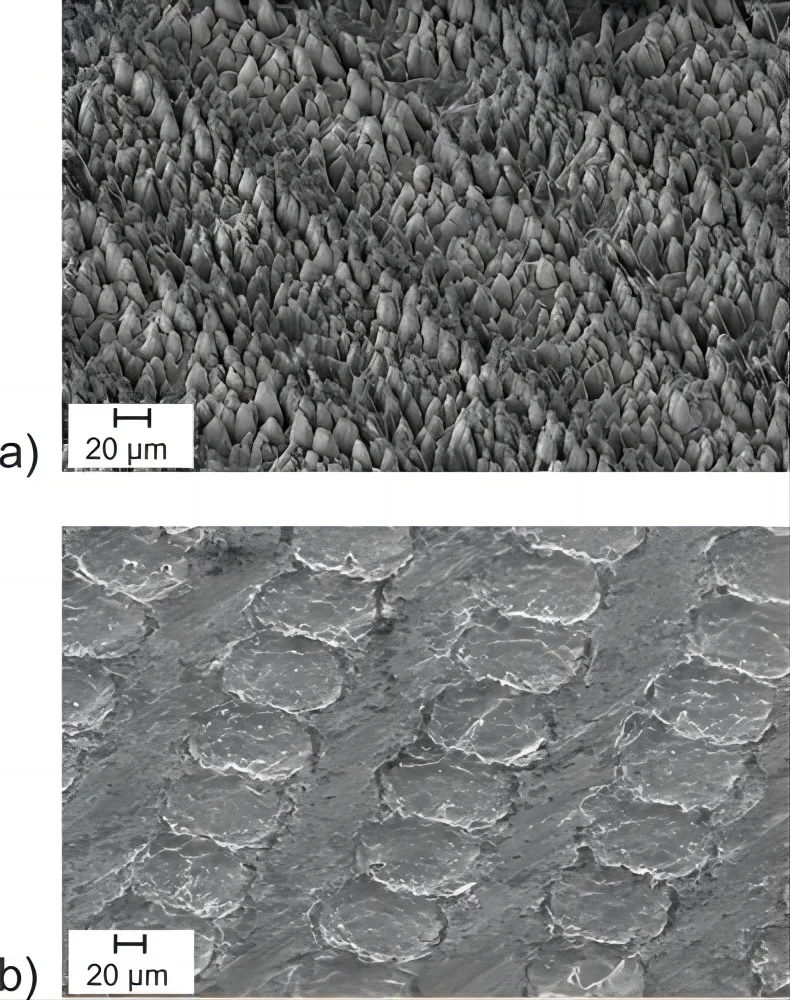
Figure: SEM image of an aluminum surface processed with laser pulses.
With technological development, the application of femtosecond lasers in conical drilling is gradually increasing. Femtosecond lasers are known for their extremely high precision and control, and are especially suitable for making small-size, high-precision conical holes. Femtosecond laser drilling can precisely control the size, depth, and angle of holes, which is crucial for applications requiring extremely high precision. For example, in the production of miniature electronic devices and precision medical devices, femtosecond lasers can achieve higher precision and consistency than traditional drilling methods.
In addition, the application of femtosecond lasers in conical drilling also has the advantage of reducing thermal effects on the material, which is especially important for processing heat-sensitive materials or maintaining material integrity. The high precision and low thermal impact of the femtosecond laser make it an ideal choice for processing complex materials and precision components.
In summary, conical drilling not only plays an important role in traditional industrial applications, but under the impetus of femtosecond laser technology, its application areas and machining precision have expanded and improved significantly. With the continuous advancement and popularization of femtosecond laser technology, conical drilling will play an even more important role in aerospace, precision machinery manufacturing, medical device manufacturing, and other high-end manufacturing fields.