Milling of Complex 3D Structures
Milling of complex 3D structures using ultrafast lasers involves layer-by-layer material removal via controlled ablation to fabricate intricate, freeform three-dimensional geometries such as microfluidic channels, nozzles, and turbine blades. This technology enables high design flexibility and sub-micrometer accuracy in advanced manufacturing.
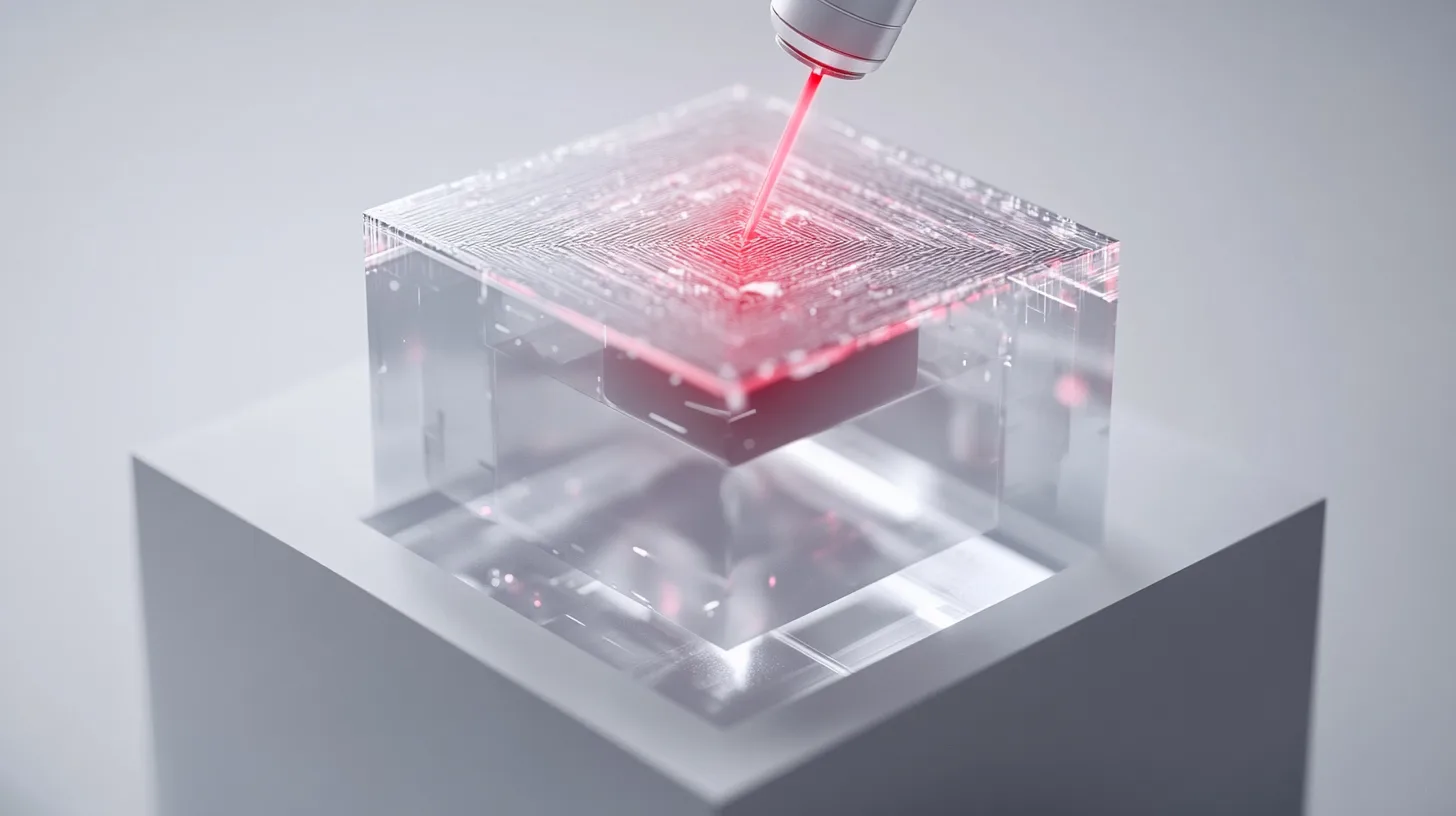
Milling of complex 3D structures is a highly precise machining technology that plays a vital role in modern manufacturing. The core of this technology lies in the use of computer numerical control (CNC) milling machines, which, through advanced software control systems, precisely move the cutting tool along a three-dimensional path to cut complex shapes out of block material. This process requires not only high precision and reliability of the machine itself but also precise matching of the cutting tool and cutting parameters (such as speed, feed rate, and depth of cut) to ensure the quality and precision of the final product.
Multi-axis synchronous control is a key feature of complex 3D milling technology. In traditional three-axis milling machines, the workpiece or cutting tool can move in the X, Y, and Z directions. In multi-axis machines, additional rotary axes (such as the A and B axes) are added, enabling more complex rotation and tilting motion of the workpiece or cutting tool. This multi-dimensional motion capability greatly expands the possibilities of milling, allowing machines to produce parts with complex curved surfaces and hard-to-reach internal structures, which is crucial for industries such as aerospace, automotive, and mold manufacturing.
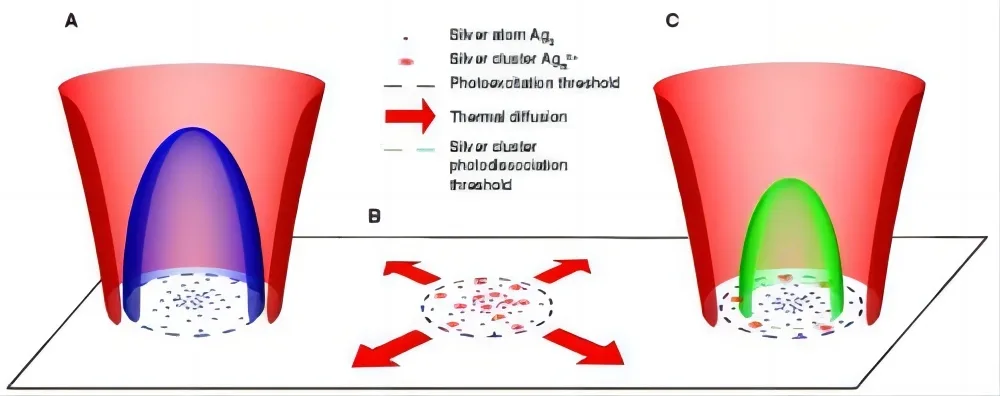
Figure 1: Schematic of nanostructure formation. (A) After laser irradiation, released photoelectrons are captured by Ag ions, forming silver atoms; (B) after 1000 pulses, local temperature rises and diffusion occurs, forming silver clusters; (C) subsequent laser pulses photodissociate the newly formed clusters, leaving cylindrical nanostructures composed of silver clusters.
In aerospace, for example, complex 3D milling is used to produce components with highly complex geometries, such as turbine blades and engine housings. These parts require not only extremely high structural strength and fatigue resistance but also surface finish and dimensional accuracy that meet strict standards. In the automotive industry, this technology is used to manufacture complex molds and components, such as gears and transmission-system parts, whose production demands extremely high precision and reliability.
The fields of art and architectural design are increasingly adopting complex 3D milling technology to create artworks and architectural models with unique designs and complex structures. The flexibility and high precision of this technology enable designers to turn their creative ideas into physical works — whether complex sculptures or fine architectural models — through precision milling.
As technology continues to advance, femtosecond laser milling, as a technology that complements and replaces traditional mechanical milling, is beginning to show its unique advantages in specific application scenarios. Femtosecond laser milling achieves fine processing of materials by producing ultrashort laser pulses, which is especially important in the manufacture of medical devices and MEMS that require extremely high precision and microstructures. Compared with traditional mechanical milling, femtosecond lasers can process materials without producing a heat-affected zone — a major advance for sensitive materials prone to deformation or damage from heat.
In addition, another notable advantage of femtosecond laser milling is the very wide range of materials it can handle, from traditional metals and plastics to advanced ceramics and composites, and even biological tissue. This versatility and high precision give it very broad application prospects in modern manufacturing, especially in high-tech industries pursuing ultimate performance and innovative design.
In summary, milling of complex 3D structures — whether traditional mechanical milling or modern femtosecond laser milling — plays a vital role in modern manufacturing. They not only advance manufacturing technology but also provide important support for innovative design and the production of high-performance products. As technology further develops and application areas expand, the scope and influence of complex 3D milling will only continue to grow.