Stainless Steel Polishing
Ultrafast laser polishing of stainless steel removes surface asperities through controlled ablation, significantly reducing surface roughness (Ra) while preserving the part's mechanical integrity and corrosion resistance. This technique has become an important complement to traditional mechanical and electrochemical polishing in the medical and industrial sectors.
Stainless steel polishing is a key surface-treatment process aimed at improving the finish and aesthetics of stainless-steel surfaces. This process is crucial for enhancing the appearance quality and performance of stainless-steel products. Stainless steel polishing usually involves removing scratches, unevenness, and other defects from the surface to achieve a certain smoothness and brightness. Through such treatment, one can not only improve the aesthetics of stainless steel but also enhance its corrosion and stain resistance, which is significant for extending the service life of stainless-steel products.
Stainless steel polishing can be achieved by various methods, including mechanical polishing, chemical polishing, and electrolytic polishing. Mechanical polishing is a traditional method that uses abrasive materials (such as sandpaper and polishing wheels) to physically grind away the rough surface layer. This method is simple and direct, but may struggle to achieve ideal results in certain complex or fine applications. Chemical polishing dissolves tiny protrusions on the metal surface using chemical reagents to achieve a smooth effect, which is more effective for irregular surfaces or areas difficult to grind mechanically. Electrolytic polishing smooths the surface through electrochemical reactions in a specific electrolyte, achieving high-quality surface treatment while preserving the material’s inherent properties.
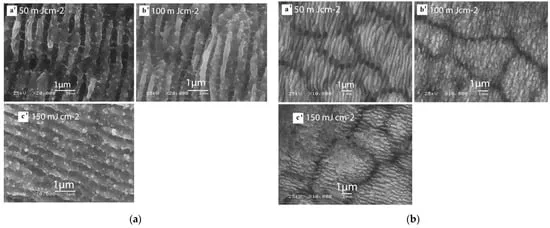
Figure: Ripple processing of AISI 304 stainless steel in an air environment. SEM images of the center and periphery of ablation zones at different fluences (50/100/150 mJ cm⁻²).
In practice, stainless steel polishing has important applications across many industries. For example, in construction, polished stainless steel is widely used to decorate and protect architectural elements such as handrails, door handles, and exterior wall cladding. These applications require not only good appearance but also sufficient weather and corrosion resistance. In the automotive industry, polished stainless steel is used to improve the attractiveness and corrosion resistance of vehicle exteriors, especially in trim parts and exhaust systems. In food processing and medical devices, polishing not only improves the aesthetics of stainless-steel surfaces but also helps improve cleanliness and antibacterial performance, which is crucial for maintaining hygiene and preventing contamination.
In recent years, with technological progress, femtosecond laser polishing has shown unique advantages in certain specific applications. Femtosecond laser polishing can be performed without contacting the material, using the high energy of the laser beam to precisely remove tiny portions of surface material, thereby achieving high-precision, high-quality surface treatment. This technology is especially suitable for stainless-steel parts requiring high precision and complex shapes, such as precision mechanical parts and complex medical devices. Because of the unique properties of the femtosecond laser, it can precisely remove material without producing a heat-affected zone, which is especially important for preserving the material’s original performance and structural integrity. In addition, femtosecond laser polishing can reduce the particle contamination that may be produced by traditional mechanical polishing, providing a cleaner and safer working environment.
In summary, stainless steel polishing is an important process widely used across many industries. The development of femtosecond laser technology has brought new possibilities to this field, improving polishing efficiency and quality while offering new solutions for complex and high-precision stainless-steel machining.