Stent Cutting
Stent cutting utilizes femtosecond or picosecond lasers to precisely machine fine strut patterns from thin-walled metal tubes, achieving high precision and virtually zero thermal damage, which is essential for manufacturing cardiovascular and peripheral vascular stents.

Stent cutting is a precision process used to manufacture vascular stents for the treatment of heart disease. A vascular stent is a small tubular device, usually made of metal or polymer, whose main function is to support and keep a narrowed or blocked blood vessel open. These stents must have sufficient mechanical strength to support the vessel, as well as appropriate flexibility to adapt to the complex vascular environment of the human body. The key to stent cutting is precisely fabricating tiny tubular mesh structures with specific patterns, apertures, and connecting geometries — structures that must guarantee both the functionality of the stent and its safety and comfort inside the body.
Stent cutting typically uses laser-cutting technology, because laser cutting can achieve high-precision, complex-pattern cutting in metal or polymer materials. During laser cutting, a highly focused laser beam precisely removes material to form the stent’s microstructure. This method not only improves cutting precision but also greatly increases design flexibility. Thus, stents of various designs can be customized to suit different patients’ specific conditions and needs.
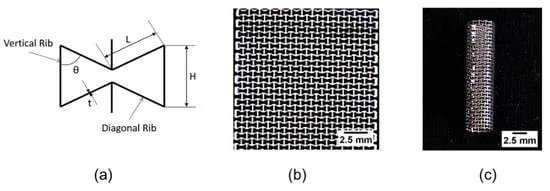
Figure: (a) unit-cell structure of a re-entrant geometry; (b) stainless-steel sheet laser-cut by femtosecond micromachining in a repeating unit pattern; and (c) a fabricated laser-welding-assisted stent.
In addition to cardiovascular applications, stent technology is also widely used in other medical fields such as the urinary, digestive, and respiratory systems to support or repair narrowed ducts and channels. In these applications, there are strict requirements for the size, shape, and physical characteristics of the stent to ensure it works effectively in different physiological environments.
In summary, stent-cutting technology plays a vital role in modern medicine, especially in the treatment of cardiovascular disease. With the development of femtosecond laser technology, stent cutting and manufacturing have become more precise and efficient, providing patients with safer and more effective treatment options. Meanwhile, the continuous advancement of this technology has opened new possibilities for the design and manufacture of medical devices.