Carrier-Envelope Phase Stabilization
Achieving repeatable alignment between the pulse envelope and the peak of the carrier electric field is the cornerstone of attosecond science for exploring electron dynamics.

The Carrier-Envelope Phase (CEP) is an extremely important concept in the field of femtosecond lasers. It refers to the phase difference between the carrier frequency of the electromagnetic wave in a femtosecond laser pulse and the peak of its envelope. In such pulses, the carrier is the electromagnetic wave that makes up the laser pulse, while the envelope describes the outline or shape of these peaks and troughs. The concept of CEP is crucial for precisely controlling the characteristics of laser pulses, especially in applications requiring extremely high temporal and spatial precision, such as precision metrology, spectroscopy, and quantum control.
CEP measurement and control technology is a key part of femtosecond laser technology. By precisely controlling and measuring the CEP, fine manipulation of the laser pulse can be achieved, which is extremely important for experimental physics and engineering applications. For example, in precision spectroscopy experiments, tuning the CEP can change the spectral distribution, thereby obtaining more experimental data and deeper understanding of light–matter interactions.
In ultrafast spectroscopy, precise control of the CEP enables scientists to more precisely study ultrafast processes inside molecules and atoms. By adjusting the CEP, researchers can change the way light pulses interact with matter, thereby revealing subtle details of chemical reactions and physical processes.
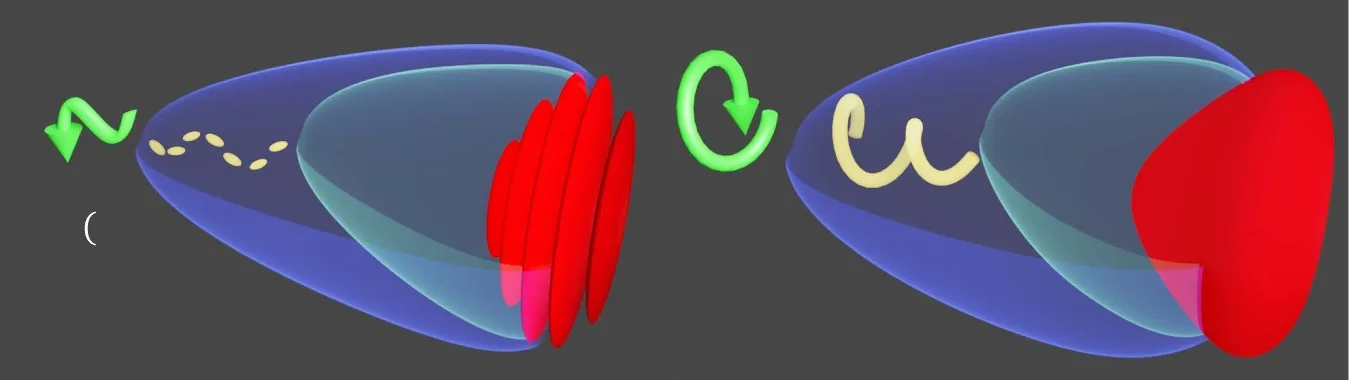
Figure 1: Schematic of electron injection driven by (a) a linearly polarized laser pulse and (b) a circularly polarized laser pulse.
In precision metrology, precise CEP control is crucial for improving measurement accuracy and resolution. Precise CEP control can improve the sensitivity and resolution of optical measurement techniques, enabling them to detect weaker or faster physical changes.
In addition, in quantum control experiments, by precisely controlling the CEP, scientists can more effectively manipulate quantum states, offering new possibilities and methods for the development of quantum information science and quantum computing. Femtosecond laser technology using CEP control can greatly improve experimental precision and repeatability. This is especially important in experiments requiring extremely high time resolution, such as studying chemical reaction dynamics or atomic physical processes, where more subtle and rapid dynamic changes can be captured.
CEP control also enables femtosecond laser technology to enter new application fields. For example, in material processing, biomedical imaging, and environmental monitoring, precisely controlled femtosecond lasers offer new experimental methods and technical means.
In summary, precise control of the carrier-envelope phase occupies an extremely important position in the field of femtosecond lasers, providing the key technology for achieving higher-precision optical measurement and control, and driving the development of scientific research and technological applications.