Flash Photolysis
A classical technique invented by Norrish and Porter in which a high-intensity light pulse initiates photochemical reactions, followed by a delayed probe pulse to monitor transient intermediates and reaction kinetics.
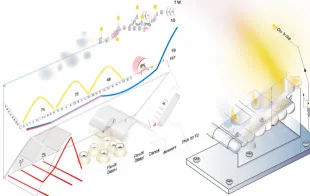
Flash photolysis is an important means of studying chemical reactions and physical processes on ultrafast timescales. In this technique, a brief high-intensity light pulse (the “flash”) irradiates the sample, rapidly triggering a chemical reaction. Subsequently, another probe light (usually another laser pulse) is used to monitor the chemical changes caused by the flash. This is usually achieved by measuring changes in the sample’s absorption spectrum.
Femtosecond lasers play a key role in flash photolysis. Because femtosecond lasers can produce extremely short light pulses, they enable scientists to study chemical reactions and transient species that occur extremely rapidly. This high-time-resolution measurement capability allows precise observation and analysis of the early stages of the reaction process, providing an unprecedented perspective for understanding reaction mechanisms and kinetics.

Figure: Study of flash photolysis using a femtosecond laser.
Flash photolysis has very broad applications in chemistry, being especially suitable for studying fast chemical reactions such as photochemical reactions, photophysical processes, and certain biochemical processes. These reactions usually occur on timescales from milliseconds to femtoseconds, involving complex kinetics and transition states.
Through flash photolysis, scientists can reveal the details of chemical reactions, especially those involving short-lived intermediates or transient species. This is crucial for analyzing complex chemical and biochemical processes, helping scientists understand reaction pathways, mechanisms, and kinetics.
The application of femtosecond lasers in flash photolysis is not limited to traditional chemical-reaction research. Its applications in biology, materials science, and other fields are also increasing. For example, in studying the dynamic structural changes of proteins, revealing the interaction mechanisms between biomolecules, and studying the optical properties of high-performance materials, femtosecond lasers provide a powerful tool.
In summary, femtosecond-laser-stimulated flash photolysis plays an important role in revealing the microscopic mechanisms of chemical reactions, exploring biomolecular dynamics, and studying complex processes in materials science.