Transient Absorption Spectroscopy
Transient absorption spectroscopy is a pump-probe technique that measures time-resolved changes in the absorption spectrum of a sample following photoexcitation, providing direct insight into excited-state dynamics and relaxation pathways.
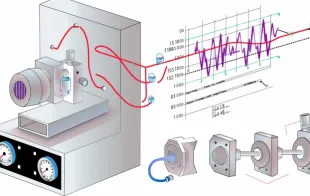
Transient Absorption Spectroscopy (TAS) is a time-resolved absorption spectroscopy technique using ultrafast laser pulses. It can provide information on molecular structure and dynamic changes on ultrafast timescales (picosecond to femtosecond), including the evolution of electronic, vibrational, and spin states after photoexcitation, as well as processes such as chemical reactions, energy transfer, and photosynthesis.
In a TAS experiment, the sample is first excited by a femtosecond laser pulse, producing transient species. Then, another light beam (the probe light) is used to measure the absorption spectrum of the sample after excitation. By changing the time delay between the excitation and probe light, the process of the sample returning from the excited state to the ground state can be recorded. TAS provides information on the absorption characteristics of molecules in the excited state, including excited-state lifetime, the formation and decay of intermediates, and energy-transfer processes.
TAS has very broad applications and can be used in materials science, biomedicine, chemistry, and more. In materials science, TAS can be used to study the electronic structure, photophysical properties, and photocatalysis of materials. In biomedicine, TAS can be used to study the structure and dynamic changes of biomolecules and drug mechanisms. In chemistry, TAS can be used to study the kinetics of chemical reactions, especially photoinduced chemical processes and catalytic mechanisms.
The ultrashort pulses produced by femtosecond lasers allow precise transient excitation of samples, which is crucial for capturing ultrafast dynamic processes. The use of femtosecond lasers significantly improves the time resolution of TAS, enabling it to observe fast processes occurring on femtosecond-to-picosecond timescales.
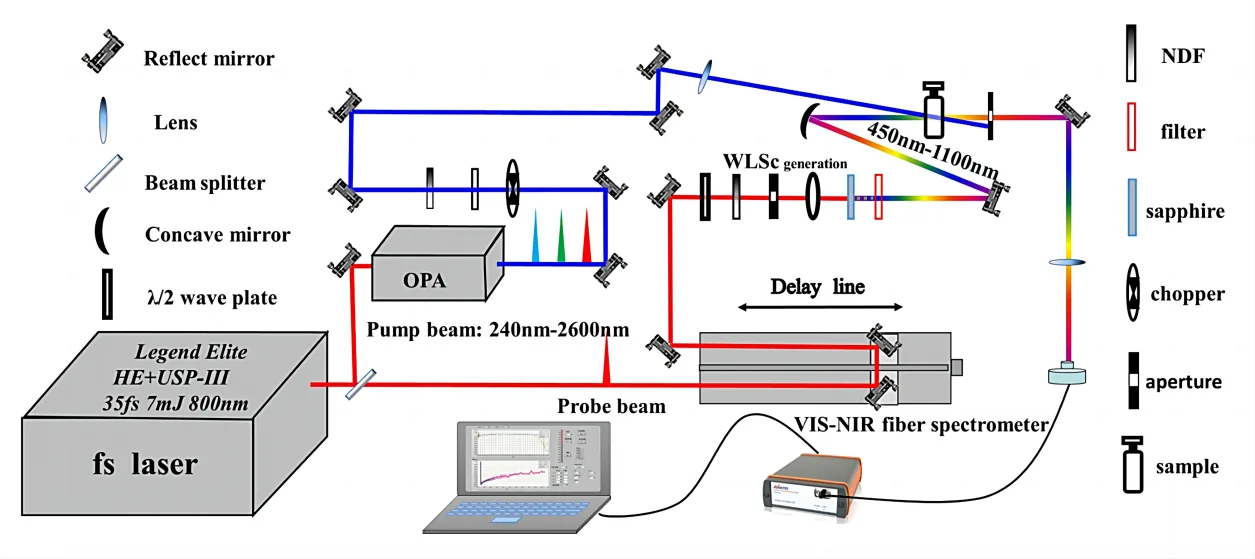
Figure: Typical optical path of a femtosecond transient absorption spectroscopy system.
In a transient absorption spectroscopy setup, the laser output from a femtosecond laser amplifier is split; a stronger beam passes through an optical parametric amplifier to produce a wavelength-tunable pump light in the UV–IR range, while a weaker femtosecond beam is focused by a concave mirror onto a crystal (CaF₂, sapphire, and YAG) to generate a supercontinuum white light via nonlinear processes such as self-phase modulation, serving as the probe light. The pump light, after passing through an optical translation stage that controls the time delay, overlaps with the probe light at the sample, and the supercontinuum white light is then coupled into a fiber spectrometer for spectral detection. In each relaxation cycle, the probe pulse intensity is recorded both with and without the pump pulse present. During this process (differential absorption spectroscopy), the change in absorbance ΔA(λ,t) is recorded to evaluate signals related to excited states and photoinduced species formation.
Required components: femtosecond laser source, optical parametric amplifier (OPA), chopper, mirrors, lenses, half-wave plate, beam splitter, attenuator, parabolic mirror, delay line, and spectrometer.