PROMETHEUS-THz
Strong‑Field Terahertz Spectroscopy System
- Peak electric field > 10 MV/cm, guaranteed ≥ 8 MV/cm — capable of directly driving materials rather than merely probing them
- 1.0 – 4.6 THz flat‑top spectrum, 10 dB in‑band across 2.2 octaves, with uniform signal strength over the full bandwidth
- Pulse energy 4 µJ, pump‑to‑THz conversion efficiency 0.6 – 0.9%
- Two focal stations at 0.14 / 0.26 mm — balancing tight focusing with ample space for sample manipulation

PROMETHEUS‑THz Strong‑Field Terahertz Spectroscopy System integrates a femtosecond Yb laser, a few‑cycle nonlinear pulse compressor, and a strong‑field terahertz time‑domain spectrometer into a single factory pre‑aligned platform. It is designed for research groups that need field‑driven, nonlinear, and high‑dynamic‑range THz spectroscopy — experiments that previously required researchers to build and maintain the entire optical path themselves. This system moves that work upstream to the factory.
What truly sets this source apart is its spectral shape. Most THz sources exhibit a sharp peak at a single frequency with rapid roll‑off on both sides, so a single measurement shows a strong signal at the peak while the rest of the spectrum is buried in noise. The output of PROMETHEUS‑THz, however, stays within 10 dB of its peak across the entire 1.0–4.6 THz range — a bandwidth of 3.6 THz spanning 2.2 octaves — and arrives at the sample as a single pulse. A single scan therefore yields uniformly high‑quality data across the full bandwidth, with no favored frequencies.
On the driving end, a Yb‑doped HELIOS‑HE femtosecond laser provides up to 2 mJ of pump energy at 10–100 kHz, which is then compressed by a HYPERION‑G‑HE gas multi‑pass cell to a typical 29.2 fs with compression efficiency better than 90%. The output is a circular, single‑lobe beam rather than the butterfly distribution commonly seen with OPA‑driven sources. Only a clean circular beam can be focused into a compact, symmetric focal spot — the prerequisite for converting pump energy into peak THz field strength. When the peak electric field exceeds 10 MV/cm, its magnitude becomes comparable to the internal field binding electrons to atoms — the pulse no longer merely observes the sample, it drives it.

Carrier-Envelope Phase Stabilization
Achieving repeatable alignment between the pulse envelope and the peak of the carrier electric field is the cornerstone of attosecond science for exploring electron dynamics.
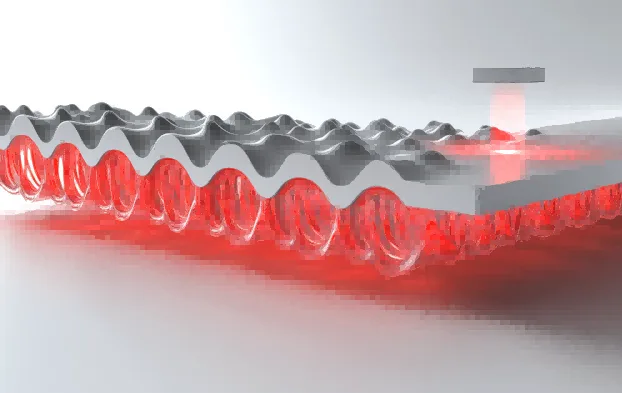
Laser-Induced Periodic Surface Structures (LIPSS)
Periodic surface structures refer to regular, repeated patterns—typically with sub-wavelength or micro-scale periods—formed on material surfaces by ultrafast laser irradiation, often via interference or self-organization effects. These structures are widely used to tailor surface properties such as wettability, color, antireflectivity, and friction.
Parameter | Specification |
|---|---|
Terahertz Output | |
Flat‑top bandwidth | 1.0 – 4.6 THz (10 dB in‑band; 3.6 THz bandwidth, 2.2 octaves) |
Peak electric field strength | > 10 MV/cm in routine operation; guaranteed minimum 8 MV/cm |
Spectral peak | 3.4 THz |
Usable spectral extension | Up to 12 THz |
Pulse energy | 4 µJ |
Pump‑to‑THz conversion efficiency | 0.6 – 0.9% (pump pulse energy ~0.7 mJ) |
THz repetition rate | One THz pulse per pump pulse, following the driving laser at 10 – 100 kHz |
Detection method | Electro‑optic sampling; measures electric field rather than power |
E‑field calibration | Diamond Kerr rotation method; cross‑validated against independent calibration on another source, with ~8% deviation |
Focusing & Beam Path | |
Focal station 1 | Spot size 0.14 mm — tight focusing, smallest spot, highest field strength |
Focal station 2 | Spot size 0.26 mm — sample station, with more space around the sample for manipulation |
Pump‑probe combinations | Four: optical / THz pump × optical / THz probe; switching requires no optical path rebuild |
Built‑in cameras | THz + laser, provided at both focal stations |
Delay line | Motorized, picosecond‑level stepping; minimum step 0.015 ps |
Temporal resolution | ~1 ps |
Beam height | 135 mm |
Optical path configuration | Off‑axis parabolic mirror relay, housed in a dry‑purged enclosure |
Footprint | 120 × 90 cm |
Driving Laser · HELIOS‑HE | |
Model | HELIOS‑10W‑HE / 20W‑HE femtosecond Yb laser |
Max average power | 10 W / 20 W |
Max pulse energy | 1 mJ / 2 mJ |
Center wavelength | 1036 ± 5 nm |
Pulse duration | < 250 fs (typical 193.5 fs) |
Repetition rate | 10 – 100 kHz |
Pulse duration tuning range | 250 fs – 10 ps |
Beam quality | M² < 1.2 (typical 1.10) |
Beam diameter | 5 ± 1 mm (10 W) / 6.2 ± 0.6 mm (20 W) |
Polarization | Linear, vertical |
Power stability | < 0.5% RMS over 24 h |
Pulse Compressor · HYPERION‑G‑HE | |
Input pulse duration | 150 fs – 1 ps |
Input pulse energy | 400 – 2000 µJ |
Max compatible power | 80 W |
Typical compression factor | 5 – 10 |
Compressor efficiency | > 90% |
Typical output pulse duration | < 35 fs (typical 29.2 fs) |
Cascading option | Optional hollow‑core fiber stage for further compression to few‑cycle |
Dimensions | 958 × 416 × 222 mm (L × W × H) |
Weight | 85 kg |
Imaging & Integration | |
THz imaging | Real‑time THz camera + f/0.7 imaging objective |
Verified feature size | 3 mm (single short exposure, no post‑processing) |
Photoconductive switch demo | Signal change > 90%, edge width sub‑picosecond |
Lock‑in detection | Lock‑in amplifier + optical chopper |
Cooling | Water‑cooled (laser and compressor) |
Warranty | 24 months after acceptance |
Installation | Factory integration and FAT, on‑site commissioning and SAT |